Supply Chain

The challenges of modern industrial planning
In an industrial environment marked by market volatility, supply chain disruptions, and growing pressure on lead times, production planning has never been so strategic. Companies that excel at planning cut their inventory by 20 to 30%, improve their customer service level by 15 to 25%, and increase their productivity by 10 to 20%.
Yet many manufacturers are still operating in the dark: struggling to anticipate production bottlenecks, allocating resources poorly, holding endless planning meetings that lead to no decisions, lacking visibility into actual capacity... These issues all share the same root cause: an industrial planning system that is poorly structured or simply missing.
Industrial planning is not just an Excel file or an ERP function. It is a structured, multi-level process that must smoothly connect the long-term strategic vision (S&OP), medium-term tactical planning (MPS), the short-term load/capacity balance, and day-to-day operational scheduling.
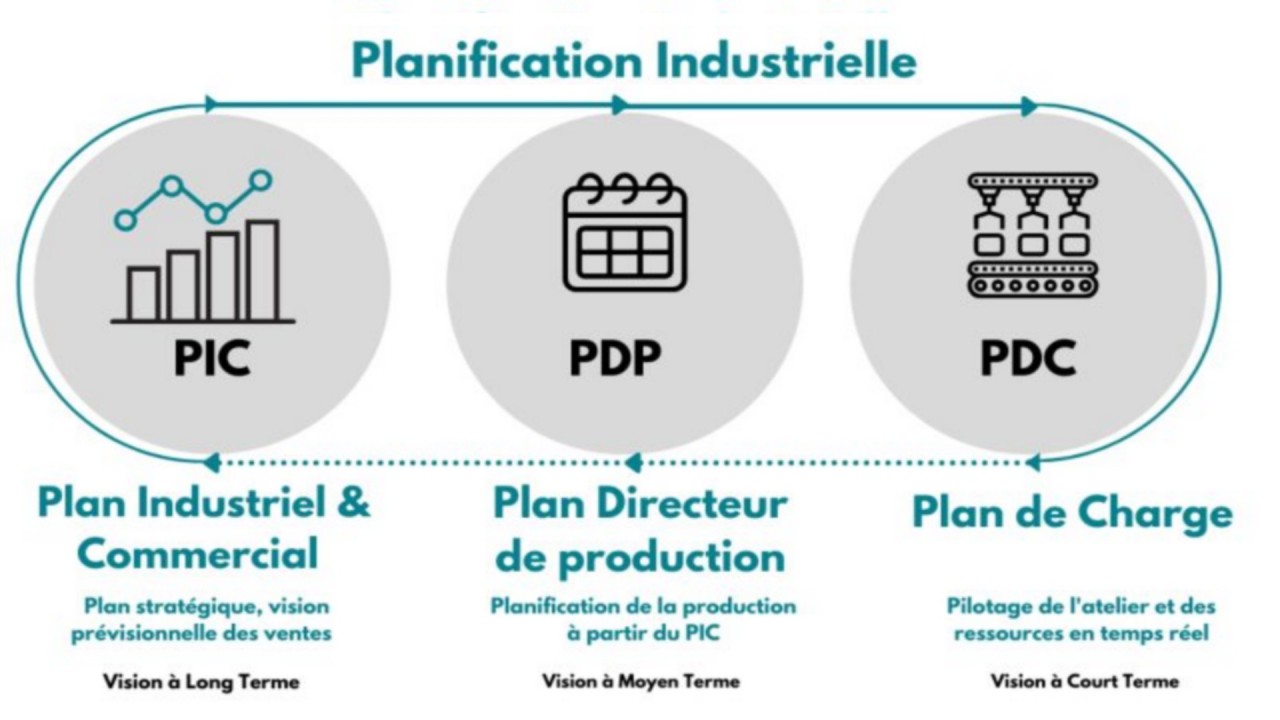
This article offers an in-depth look at the four levels of industrial planning: S&OP (Sales & Operations Planning), MPS (Master Production Schedule), the load/capacity plan, and scheduling. For each level, we will detail:
The required inputs: which data feeds this level of planning?
The update frequency: how often should these plans be revised?
The precise definitions: what exactly does each level cover?
The main objectives: why and how does this level contribute to performance?
By mastering these concepts and structuring your S&OP, MPS, capacity planning, and scheduling process, you will have a robust framework to steer your production effectively, anticipate pressure points, and make the right decisions at the right time.
These four levels form an integrated system in which each level draws its inputs from the level above it and feeds its own constraints back up. It is this end-to-end planning loop, running from S&OP through MPS and capacity planning down to scheduling, that ensures the coherence and effectiveness of the whole system.
S&OP (Sales & Operations Planning): strategic alignment
Definition and role of S&OP
S&OP (Sales & Operations Planning), known in French as the Plan Industriel et Commercial (PIC), is the first strategic stage of industrial planning. It is a periodic, collaborative decision-making process that aims to balance commercial demand against the company's overall capacity over a 12-to-18-month horizon.
S&OP sits at the most macro level of the planning chain. It works on product families (groups of products that share similar manufacturing processes and resources) rather than on individual SKUs. This aggregated approach makes it possible to maintain a strategic view without getting lost in the detail.
According to Pulsa Conseil, S&OP answers three fundamental questions:
What are the priorities: what to produce, how much, and by when?
What capacity is available: labor, equipment, financial resources?
How to balance the two while respecting strategic objectives?
Key S&OP inputs
Building a robust S&OP requires several essential inputs:
Sales and marketing data:
Sales forecasts by product family
Order book of firm and forecast customer orders
New-product launch plans
Market trends and seasonality
Capacity data:
Overall production capacity by site / unit
Available human resources (projected headcount)
Raw-material supply constraints
Planned investments (new machines, expansions)
Financial data:
Revenue and margin targets
Operating budget and cash-flow constraints
Inventory-level targets (carrying costs)
Operational data:
Current finished-goods inventory by family
Average production lead times by family
Available storage capacity
S&OP frequency and method
S&OP is generally revised on a monthly basis, sometimes quarterly in low-variability sectors. This frequency makes it possible to:
React to market changes without falling into micro-management
Prepare investment decisions with enough lead time
Gradually adjust plans based on actual results
The structured S&OP method recommends a five-step process:
Data update: consolidating forecasts and actuals
Demand review: validating commercial assumptions
Supply review: validating industrial feasibility
Pre-S&OP meeting: preparing scenarios and recommendations
Executive S&OP meeting: final arbitration by the leadership team
This monthly meeting involves the key functions: General Management, Sales/Marketing, Supply Chain, Production, Finance, and HR.
S&OP objectives
The main objectives of S&OP within the S&OP, MPS, capacity planning, and scheduling process are:
✅ Align the organization: build consensus between commercial objectives (revenue growth) and industrial constraints (available capacity)
✅ Balance overall load and capacity: ensure the forecast volumes are achievable with current resources, or plan the necessary investments
✅ Provide a framework for the MPS: set a clear trajectory for the Master Production Schedule over the next three to six months
✅ Optimize financial resources: arbitrate between capacity investments, safety stock, and service level
✅ Anticipate pressure points: identify the risk of overload or underload early enough to make the right decisions (hiring, subcontracting, investment)
A well-built S&OP makes it possible to manage production resources so as to balance the workload against capacity over the long term.
MPS (Master Production Schedule): turning strategy into concrete action
Definition and scope of the MPS
The Master Production Schedule (MPS), known in French as the Plan Directeur de Production (PDP), is the second level of industrial planning. It translates the strategic objectives set in S&OP into a more precise tactical plan over a three-to-six-month horizon.
Unlike S&OP, which reasons in terms of product families, the MPS drills down to the level of finished products or main SKUs. It answers the essential operational questions:
What should I produce? (which exact items)
How much? (precise quantities)
When? (week by week)
The MPS acts as a contract between sales and production. On one side, it gives sales guarantees about what can be delivered. On the other, it shields production from abrupt swings that would be impossible to absorb.
MPS inputs
The MPS relies on more precise and more up-to-date data than S&OP:
From S&OP:
Validated overall volumes by product family
Macro capacity constraints
Inventory-level targets
Updated sales data:
Firm customer orders already booked
Sales forecasts by SKU (detailed forecast)
Customer priorities (framework contracts, strategic accounts)
Industrial data:
Machine capacity by work center
Labor availability (HR schedule, time off)
Current finished-goods inventory by SKU
Work-in-progress (work orders already released)
Supply data:
Availability of raw materials and components
Current supplier lead times
Defined safety stock
The MPS is more representative of production than S&OP because it draws on actual orders in addition to forecasts.
MPS frequency and tools
The MPS is updated on a weekly basis, or even daily in highly dynamic environments. This regular revision makes it possible to:
Incorporate new customer orders
Adjust to capacity variations (breakdowns, absences)
Reassess priorities according to emergencies
To manage this complexity, high-performing companies rely on dedicated tools:
ERP (Enterprise Resource Planning): master-data management and basic simulation
APS (Advanced Planning & Scheduling): advanced load/capacity scenario simulation
Specialized solutions such as Oplit: collaborative planning with real-time simulation
These tools make it possible to simulate different production scenarios and choose the most optimal one against multiple criteria: service level, costs, inventory, and lead times.
MPS objectives
Within the S&OP, MPS, capacity planning, and scheduling process, the MPS plays a pivotal role, with the following objectives:
✅ Maximize the customer service level: ensure orders are delivered within the promised lead times
✅ Ensure the plan is industrially feasible: confirm that the planned volumes can genuinely be produced with the available resources
✅ Optimize the inventory/production balance: avoid both stockouts and costly overstocking
✅ Serve as the basis for the load plan: provide the inputs needed to validate detailed feasibility at the resource level
✅ Enable simulation: provide the ability to assess the impact of different assumptions (adding a customer, a supplier delay, etc.)
The MPS makes it possible to track actual sales against the forecasts set in S&OP, thereby creating a loop of learning and continuous improvement.
The load plan and finite-capacity planning: the reality on the floor
Definition and importance of the load plan
The load plan is the third level of the S&OP, MPS, capacity planning, and scheduling process. Its role is to validate the operational feasibility of the MPS by comparing the planned workload against the actual capacity available.
Unlike the previous levels, which can work in "infinite capacity" mode (plan first, adjust later), the load plan introduces the notion of finite capacity: it checks that each resource (machine, workstation, operator) will not be overloaded.
The load plan answers three critical questions:
Where are the bottlenecks? Which resources will saturate first?
How can the load be smoothed? Can some work orders be shifted to avoid peaks?
Which levers to pull? Should we add overtime, subcontract, or hire?
Load-to-capacity matching consists in estimating the resources to be mobilized to meet a given demand over a given period. This analysis compares the resource requirement against the available means.
Load-plan inputs
To carry out a meaningful load/capacity analysis, the following data is essential:
From the MPS:
List of SKUs and quantities to produce per period
Forecast production schedule
Detailed technical data:
Process routings: the sequence of operations for each product
Standard times: manufacturing durations per operation (unit time + setup time)
Bills of materials (BOM): the components required for each product
Routings: the assignment of operations to workstations
Capacity data:
Machine availability: operating calendar, planned maintenance hours
Workforce availability: staff present, skills, cross-training
Actual efficiency: observed vs. theoretical performance rate (OEE)
Constraints: available tooling, storage areas, raw materials
Load-plan frequency
The load plan is revised on a weekly basis, or even daily in high-variability environments. This high frequency makes it possible to:
React quickly to disruptions (breakdowns, absences, supplier delays)
Adjust priorities according to customer emergencies
Anticipate load pressure before it becomes critical
In sectors such as aerospace, automotive, or special-machine building, load/capacity management can even be done in real time thanks to MES (Manufacturing Execution System) or advanced APS solutions.
Load-plan objectives
The objectives of the load plan within the S&OP, MPS, capacity planning, and scheduling system are:
✅ Identify production bottlenecks: pinpoint the critical resources that limit overall capacity
✅ Arbitrate priorities: decide which work orders to release first given the capacity constraints
✅ Smooth the load: spread the workload evenly over time to avoid peaks and troughs
✅ Adjust the plan: modify the MPS if necessary to make it genuinely feasible
✅ Activate capacity levers: decide on concrete actions (overtime, subcontracting, postponing maintenance, etc.)
✅ Provide visibility: give production managers a clear view of the upcoming load
The load plan makes it possible to steer the shop floor by establishing a schedule of the quantities to produce along with release and delivery dates.
Infinite capacity vs. finite capacity
A key concept to understand in capacity planning:
Infinite capacity:
Work orders are planned without regard to capacity limits
You can end up with utilization rates of 300% or 500%
Useful for identifying overloads, but not for running the shop floor
Finite capacity:
The capacity limits of each resource are respected (max 100%)
If a workstation is saturated, the work order is automatically shifted or assigned to an equivalent station
Realistic and executable planning
Modern software such as Oplit makes it possible to simulate finite-capacity scenarios to validate feasibility before releasing work orders.
Scheduling: the ultimate level of precision
Definition and role of scheduling
Scheduling (ordonnancement in French) is the fourth and final level of the S&OP, MPS, capacity planning, and scheduling process. It is the most operational level, the one closest to execution on the floor.
Scheduling consists in defining the optimal execution order of work orders, taking into account all shop-floor constraints: the availability of machines, operators, tooling, and materials, as well as customer priorities and delivery requirements.
Scheduling is "the arrangement that allows tasks to be executed sequentially so that the whole production run is completed within the allotted time".
The fundamental difference from the load plan:
The load plan checks that, overall and across a week, there is enough capacity
Scheduling decides precisely: on Monday morning, run work order 12345 on machine M1, then work order 67890 on M2, and so on
Scheduling inputs
Scheduling relies on very fine-grained data updated in real time:
From the load plan:
List of work orders to release per period
Forecast load per resource
Real-time floor data:
Machine status: available, in production, down, under maintenance
Operator availability: present, skills, current assignments
Work-order progress: which operation is underway, how much remains to be done
Available stock: materials and components actually available in the warehouse
Available tooling: tools, molds, and jigs that are free or in use
Priorities and constraints:
Customer delivery dates: firm commitments
Sequencing constraints: costly changeovers to minimize
Business rules: preference for certain work orders on certain machines
Technical constraints: certain operations must follow one another without delay
Scheduling frequency
Scheduling operates in real time or with a daily update, sometimes several times a day. This responsiveness is essential because the shop floor is subject to many disruptions:
Unplanned machine breakdowns
Last-minute operator absences
Supply delays
Quality rejects forcing a run to be redone
Urgent orders inserted as top priority
Modern scheduling tools (APS, MES) enable an automatic update of the schedule as soon as an event occurs, ensuring that everyone works on the most recent version of the plan.
Scheduling objectives
Within the complete S&OP, MPS, capacity planning, and scheduling system, scheduling aims to:
✅ Guarantee smooth execution: ensure every operator knows at all times which work order to handle first
✅ Optimize lead times: minimize waiting time between operations and reduce throughput time (lead time)
✅ Reduce WIP (Work In Progress): limit work-in-progress to improve cash flow
✅ Improve responsiveness to disruptions: automatically recompute the optimal schedule when an incident occurs
✅ Provide operational visibility: give all stakeholders (production, logistics, sales) a clear view of progress
✅ Optimize resource utilization: maximize the utilization rate of machines and operators by reducing downtime and transitions
✅ Respect customer priorities: ensure that urgent or strategic orders are handled first
Scheduling corrects assumptions against the day's reality and sequences tasks and work orders according to shop-floor constraints.
Scheduling methods and algorithms
Scheduling uses different priority rules to decide the order of processing:
Classic rules:
FIFO (First In, First Out): first come, first served
LIFO (Last In, First Out): last in, first served
EDD (Earliest Due Date): the nearest delivery date first
SPT (Shortest Processing Time): the shortest duration first
CR (Critical Ratio): the ratio between time remaining and work remaining
Advanced optimizations:
Minimizing changeovers: grouping similar work orders
Load balancing: spreading work across equivalent stations
Accounting for constraints: mandatory sequences, limited tooling
Modern software solutions such as Oplit incorporate these algorithms to automatically propose the best schedule according to the defined objectives.
In summary: coherence across S&OP, MPS, load, and scheduling
How to ensure continuity between levels
The performance of an S&OP, MPS, capacity planning, and scheduling system rests on coherence and synchronization across all levels. Here are the key principles:
1. The importance of reliable data
Each level relies on the outputs of the previous one. If the data is wrong from the outset (unrealistic sales forecasts, obsolete routings, overestimated OEE), the entire planning chain will be distorted.
The critical data to make reliable:
Regularly updated sales forecasts
Manufacturing routings and standard times that reflect reality
Actual performance rates (OEE), not theoretical ones
Physical inventory that matches system inventory
Machine availability that includes preventive maintenance
2. Synchronizing the planning horizons
The horizons must overlap to ensure continuity:
S&OP (12–18 months) encompasses the MPS (3–6 months)
The MPS (3–6 months) comfortably covers the load plan (one week to three months)
The load plan feeds daily scheduling
This temporal cascade ensures there is always enough visibility to make the right decisions.
3. Using integrated software
High-performing companies rely on tools that natively integrate the different planning levels:
ERP (SAP, Oracle, etc.): the data backbone and transactional management
Advanced APS (Oplit, Demand Solutions, etc.): simulation and optimization
MES: real-time feedback on shop-floor progress
These tools enable:
An automatic flow of data from one level to the next
Scenario simulation to assess the impact of decisions
Traceability of the plan's successive versions
Collaboration between the different departments
Modern planning solutions connected to the ERP make it possible to run load/capacity simulations to explore several scenarios and optimize the MPS upstream.
Best practices for effective planning
Regular, well-framed S&OP meetings
A monthly cadence respected religiously
A structured agenda and upfront preparation
Decisions made in the meeting (no deferrals)
Minutes and an action plan circulated within 24 hours
Systematic variance analysis
Compare planned vs. actual at every level
Understand the causes of variances (disruptions, planning errors, bad data)
Put corrective actions in place
Capture the lessons learned to improve future forecasts
Collaborative tools and digitalization
Abandon scattered Excel files
Centralize planning in a single tool
Give each stakeholder the visibility they need
Automate calculations and simulations
A planning culture
Train everyone in the concepts of S&OP, MPS, capacity planning, and scheduling
Make the interdependence of decisions clear
Hold each level accountable for its commitments
Recognize planning performance (KPIs, incentives)
Case study: the value of integrated planning
The starting point of an industrial SME
The company: a 150-person SME manufacturing mechanical components for the automotive sector, with both series and make-to-order production.
Issues identified:
A customer service level of 72% (target: 95%)
Work-in-progress: 8 weeks of tied-up inventory
Weekly planning meetings lasting 3 hours with no clear decisions
Bottlenecks identified too late
Sales teams unable to give reliable delivery dates
Root cause: the absence of any planning structure. There was no S&OP, the MPS was a simple Excel file, there was no load/capacity tool, and scheduling was done manually on a whiteboard.
Rolling out an S&OP, MPS, capacity planning, and scheduling process
Phase 1: Structuring S&OP
Setting up a monthly S&OP meeting
Creating product families
Defining overall capacity by family
Aligning sales / production / finance
Phase 2: Deploying an MPS tool
Implementing Oplit, connected to the ERP
Training the planners
Load/capacity simulation before releasing work orders
Phase 3: Detailed scheduling
Finite-capacity scheduling by work center
Displaying priorities on the shop floor
Daily updating of progress
Results after 12 months
Operational performance:
Customer service level: 72% → 94% ✅
Work-in-progress: 8 weeks → 4 weeks ✅
Planning-meeting time: 3h → 45min ✅
Financial gains:
Inventory reduction: -35% → €800K of cash freed up
Productivity gain: +12% thanks to better sequencing
Overtime reduction: -25%
Improved visibility:
Sales reps can confirm a date in 5 minutes (vs. 2 days before)
Production managers spot pressure points 3 weeks in advance
Management has a consolidated, six-month view of the load
Key success factors
✅ Executive sponsorship: strong involvement from the Operations Director
✅ Training: everyone trained in the planning concepts
✅ The right tool: an Oplit solution sized for the company, not an oversized ERP
✅ Support: an external consultant for the first three months to structure the processes
✅ Continuous improvement: a quarterly review of the process, with adjustments
This case demonstrates the concrete impact of a well-structured, well-equipped S&OP, MPS, capacity planning, and scheduling system.
Structure your planning to boost performance
Multi-level industrial planning is not optional; it is a necessity in today's competitive environment. Companies that excel at planning systematically outperform their competitors on service level, costs, and profitability.
The S&OP, MPS, capacity planning, and scheduling system detailed in this article is the proven methodological foundation for structuring your planning effectively:
From strategy to operations, each level plays a key role:
S&OP aligns the organization over the long term and sizes strategic capacity
The MPS translates that vision into a concrete production plan and simulates feasibility
The load plan validates the load/capacity balance and identifies bottlenecks
Scheduling optimizes day-to-day execution and reacts to disruptions
The concrete benefits of a well-structured system:
✅ A 15-to-25-point improvement in customer service level
✅ A 20-to-35% reduction in inventory and work-in-progress
✅ A 10-to-20% productivity gain
✅ Less overtime and emergency subcontracting
✅ A better working climate (less stress, clear priorities)
Where to start?
If your company does not yet have a structured S&OP, MPS, capacity planning, and scheduling process, here are the first steps:
Assess your maturity: where do you stand today? Excel, a basic ERP, an advanced tool?
Prioritize the work streams: start with the most critical level (often the MPS or scheduling)
Train your teams: the methodology matters as much as the tool
Choose the right tool: a solution like Oplit, specialized in industrial planning, will deliver more value than a generic ERP
Implement gradually: shop by shop, product family by product family, step by step
Take action
Industrial planning is a complex subject, but it is masterable with the right methodology and the right tools. Don't stay stuck in permanent firefighting and flying blind.
Discover how Oplit can help you structure and digitalize your S&OP, MPS, capacity planning, and scheduling process:
👉 Discover how to optimize your Master Production Schedule
👉 Request a personalized Oplit demo
By structuring your planning from S&OP through to scheduling, you will transform your production from a reactive cost center into a proactive competitive asset.