Solutions

Industrial scheduling facing the challenges of 2026
In an industrial context marked by growing pressure on delivery times, increased volatility in production costs, and ever more complex supply chains, 2026 represents a decisive turning point for production planning solutions. Plant managers, supply chain managers, and planners face unprecedented demands: meeting ever-tighter deadlines, optimizing resource use amid a shortage of skilled labor, and maintaining profitability despite rising energy costs.
Scheduling software is evolving rapidly to incorporate three fundamental pillars: operational flexibility, resilience in the face of disruptions, and artificial intelligence. These transformations are no longer marginal innovations but strategic imperatives for any manufacturer that wants to stay competitive.
This article sets out to decode the major scheduling software innovations of 2026, analyze their concrete impact on industrial operations, and help decision-makers anticipate their technology choices. Discover how solutions like Oplit anticipate these trends and transform production management.
How scheduling software has evolved: where do we stand in 2026?
From Excel to modern APS systems
For decades, manufacturers managed their production scheduling with rudimentary tools: Excel spreadsheets, paper schedules, or limited ERP modules. These traditional approaches are now showing their limits in the face of mounting constraints. According to a recent study, more than 70% of French industrial companies now consider scheduling a strategic priority for improving their competitiveness.
Traditional systems cannot simultaneously handle the many constraints of modern production: machine availability, operator skills, complex manufacturing sequences, changeover-time management, and multi-site coordination. Manual planning becomes time-consuming and error-prone, leading to delivery delays, machine overloads, and underused human resources.
Scheduling software 4.0: cloud, integration, and UX
The year 2026 marks the culmination of the digital transformation of production scheduling solutions. According to Gartner's forecasts, by 2026 at least 80% of manufacturing companies will have adopted cloud-based business applications. This migration to the cloud is not just a matter of technological fashion: it answers concrete needs for real-time data centralization, multi-site access, and lower infrastructure costs.
The 2026 scheduling software innovations are characterized by native integration with ERP, MES, and industrial IoT ecosystems. This interoperability guarantees permanent synchronization of production data, letting planners make decisions based on the real state of the shop floor. User interfaces have also evolved considerably, abandoning complex screens in favor of intuitive experiences where drag-and-drop replaces tedious configuration.
The ongoing evolution of scheduling software is moving toward greater agility, with shorter update cycles and features that are enriched continuously, without requiring heavy migrations.
Flexibility as a non-negotiable requirement
Real-time multi-scenario management
The ability to simulate several alternative schedules is one of the most anticipated scheduling software innovations of 2026. Manufacturers must be able to instantly assess the impact of a change in customer priority, an unexpected bottleneck, or a subcontracting decision. This operational flexibility radically transforms decision-making.
Modern production planning solutions let planners create and compare several scenarios in a few clicks: what happens if I prioritize this urgent order? How do I absorb this machine breakdown without affecting my deadlines? What impact will adding a night shift have? These simulations, which previously took several hours, are now done in real time thanks to cloud computing power.
Multi-site integration and the extended supply chain
The scheduling software of 2026 is no longer limited to a single shop or an isolated plant. It orchestrates production across several geographic sites, coordinating flows between factories, suppliers, and subcontractors. This extended view of production scheduling makes it possible to optimize the overall load of the industrial group, pool capacity, and smooth inter-site transfers.
Multi-site planning involves managing additional constraints: transport times between sites, customs, differing resource availability, and local regulatory specifics. Advanced solutions incorporate these parameters to propose a coherent schedule across the entire production network.
Collaborative interfaces: involving every stakeholder
The 2026 scheduling software innovations break down organizational silos. Planners, schedulers, shop-floor supervisors, operators, and sales managers all access the same information, tailored to their role. This transparency improves coordination and reduces the misunderstandings that create inefficiencies.
Collaborative interfaces let operators report disruptions directly from their workstation, salespeople check available capacity in real time to promise a realistic delivery date, and managers track progress toward production targets. This democratization of information transforms company culture and gives every stakeholder ownership.
Resilience at the heart of modern scheduling
Anticipating and absorbing disruptions
Resilience is the second pillar of scheduling software in 2026. Manufacturers face daily disruptions: supply delays, machine breakdowns, absenteeism, customer emergencies. Traditional solutions collapse in the face of these surprises, forcing time-consuming manual readjustments.
Resilient systems natively incorporate disruption management. They automatically detect deviations from the schedule, assess their cascading impact, and propose rescheduling alternatives. This rapid adaptability limits domino effects and maintains the customer service level despite disruptions.
Robust planning and dynamic buffers
Inspired by the Drum-Buffer-Rope (DBR) concepts from the Theory of Constraints, modern scheduling software incorporates dynamic protective buffers. These safety margins are no longer static but adjust automatically according to the level of risk detected on each work order.
Robust planning consists in building schedules that withstand variation rather than chasing a perfect but fragile theoretical optimum. This approach favors operational stability and drastically reduces emergency manual rescheduling.
Connectivity with the industrial digital ecosystem
The resilience of production scheduling systems rests on their ability to capture the shop floor's weak signals in real time. Integration with IoT sensors, MES interfaces, and connected machines provides instant visibility into the real state of production.
This connectivity makes it possible to anticipate problems before they occur: a drift in machine rate signals a need for preventive maintenance, a critical stock level triggers a supply alert, an abnormal scrap rate identifies a quality problem to resolve urgently. Production planning becomes predictive rather than reactive.
Artificial intelligence in scheduling software
Planning copilots: AI in service of people
Artificial intelligence is the third major revolution among the 2026 scheduling software innovations. Contrary to initial fears, AI does not replace planners but augments them. It acts as an intelligent copilot that proposes optimized work orders, which the human validates or adjusts based on their field expertise.
AI algorithms analyze millions of possible combinations to identify the production sequences that maximize Overall Equipment Effectiveness (OEE), minimize changeover times, and respect customer priorities. This multi-constraint optimization, impossible to perform manually, generates measurable productivity gains. Manufacturers that have adopted AI-assisted production scheduling solutions see significant improvements: a 70% reduction in manual schedule adjustments, delivery times cut from 10 to 3 business days, and a 50% reduction in stockouts.
Anomaly detection and proactive recommendations
AI excels at identifying abnormal patterns. Scheduling software equipped with machine-learning capabilities automatically detects the risk of delays, emerging bottlenecks, or problematic work orders. This continuous monitoring generates preventive alerts that let teams intervene before the problem materializes.
AI recommendations are continuously enriched. The system learns from past decisions, actual performance, and planner feedback to refine its suggestions. This continuous-improvement loop turns the scheduling software into a true intelligent assistant that progressively understands the specifics of each production environment.
Multi-constraint optimization and advanced algorithms
The 2026 scheduling software innovations embed sophisticated optimization algorithms drawn from operations research and machine learning. Advanced heuristics, linear programming, genetic algorithms, and neural networks work together to solve scheduling problems of unprecedented complexity.
These algorithms simultaneously account for dozens of constraints: machine capacity, operator skills, mandatory sequences, storage constraints, production targets, commercial priorities, and energy costs. AI finds near-optimal solutions in a few seconds where a human would take hours with no guarantee of an optimal result.
Explainability and trust: transparent AI
With the growing adoption of AI in production scheduling, a crucial question emerges: how can you trust the machine's recommendations? The scheduling software of 2026 incorporates explainability mechanisms that let users understand the AI's reasoning.
According to a recent study, 40% of companies see the lack of explainability as a major barrier to AI adoption. Modern solutions address this concern by displaying the decision criteria, the alternatives considered, and the trade-offs made. This transparency strengthens planners' trust and encourages acceptance of AI recommendations.
Comparison: 2026 innovations vs. past practices
What really changes compared to 2020-2025?
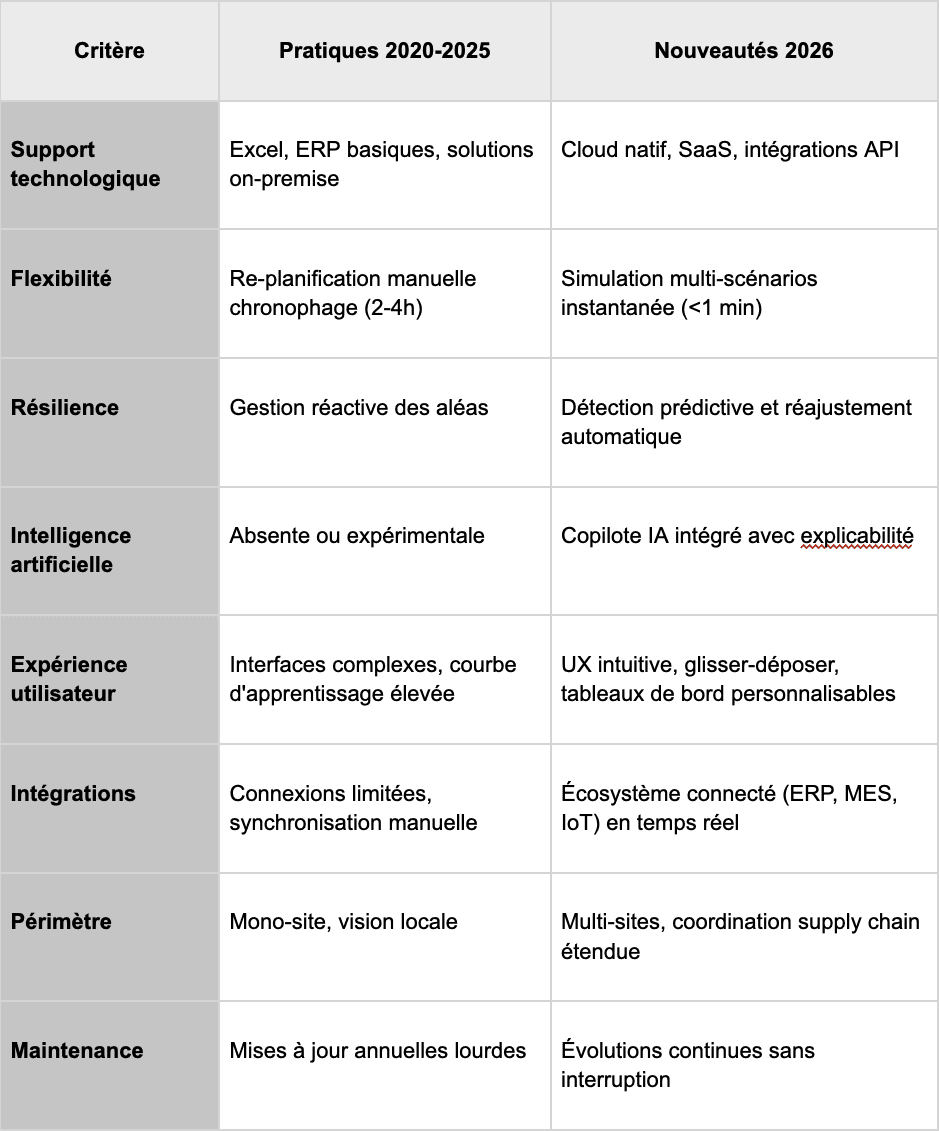
The transformation of scheduling software between 2020 and 2026 goes beyond a simple technological evolution. It represents a paradigm shift in production management. Manufacturers are gradually abandoning Excel and manual planning in favor of cloud systems with native AI.
In 2020, production planning remained largely static, with weekly or daily re-planning cycles. In 2026, scheduling becomes dynamic and continuous, adjusting automatically to shop-floor events. Planners spend less time building schedules and more time analyzing performance and driving continuous improvement.
Feature comparison table:
Best practices for preparing your company
Define your needs: flexibility vs. robustness
Before selecting a scheduling software, manufacturers must clarify their priorities. Are you mainly looking for flexibility to manage a wide variety of products and frequent changes in priorities? Or do you favor robustness to stabilize high-volume production flows?
This strategic reflection shapes the choice of solution. Some scheduling software excels at simulation and responsiveness, others at optimizing long runs and minimizing changeovers. The ideal is to find a balance suited to your industrial context.
Involve your teams from the start
The success of a production scheduling project rests as much on human acceptance as on technology. Involve planners, schedulers, shop-floor supervisors, and operators from the scoping phase. Their field feedback is essential to correctly configure the constraints and ensure the solution meets real needs.
Change management must accompany the technology rollout. Training users, explaining the benefits, gathering improvement suggestions, and celebrating early wins all foster ownership of the tool.
Start small with an AI pilot
Integrating artificial intelligence into production scheduling can seem intimidating. The recommended approach is to start with a pilot on a limited scope: one shop, one product family, or one specific type of constraint. This iterative approach makes it possible to validate the relevance of the AI recommendations, adjust the parameters, and gradually build the teams' confidence.
Manufacturers that succeed in their AI transformation adopt an MVP (Minimum Viable Product) logic: quickly deploy a first working version, measure the results, learn, and iterate. This agility accelerates the return on investment and limits the risks.
Measure the value: essential KPIs
The effectiveness of a scheduling software is measured through concrete operational indicators. The priority KPIs include the on-time delivery rate (OTD), the level of work-in-progress (WIP), production lead time, Overall Equipment Effectiveness (OEE), and schedule adherence.
Coupled with an APS (Advanced Planning & Scheduling) system, manufacturers see impressive gains: up to -50% lead time, -40% inventory, +25% throughput, and -90% customer complaints. These tangible results justify the investment in scheduling software innovations.
Conclusion and outlook: toward predictive, autonomous scheduling
The 2026 scheduling software innovations are shaping the future of manufacturing. The convergence of three pillars (operational flexibility, systemic resilience, and artificial intelligence) radically transforms production management. Manufacturers that embrace these changes will gain decisive competitive advantages: better responsiveness to disruptions, optimized resources, shorter lead times, and improved customer satisfaction.
Beyond 2026, production scheduling will evolve toward greater autonomy. Predictive systems will anticipate problems before they occur, while autonomous scheduling will take over routine decisions, calling on humans only for strategic trade-offs or exceptional situations. This human-machine collaboration will redefine the role of planners, who will become strategic pilots rather than operational administrators.
Adopting next-generation scheduling software is no longer an option but a necessity for staying competitive in a rapidly changing industrial environment. The companies that invest in these technologies today are shaping their future and positioning themselves as Industry 4.0 leaders.
Want to discover how to optimize your production scheduling? Explore the innovative solutions from Oplit and request a personalized demo to transform your industrial management.