Supply Chain

Focus on the customer-supplier relationship: the perspective of the buyer and the sales administrator
Focus on the customer-supplier relationship: the scheduler's perspective
A collaborative platform to increase productivity
Conclusion
In the complex landscape of contemporary commerce, the efficiency of supply chain management proves to be an imperative for companies aspiring to maintain their competitiveness in the market. The supply chain, which orchestrates every step from production to delivery, often faces challenges of coordination and communication between its various stakeholders. It is in this context that the need to connect the key players in the supply chain takes on its full meaning.
In this article, we will explore in detail two crucial relationships within the supply chain:
The one between the buyer and the sales administrator on the supplier side
The one between the scheduler and the sales administrator.
We will analyze the current problems and highlight the advantages of close collaboration between these players for efficient production management.
The relationship between the buyer and the sales administrator is of crucial importance for ensuring a constant flow of materials and products between suppliers and customers. However, this relationship is often hampered by problems.
Among them, delivery delays, insufficient product quality, and ineffective communication are the most common. These problems often lead to an increase in customer calls and emails to suppliers, thereby affecting the workload of the suppliers, who must devote more time to responding to requests. This work overload can disrupt operations and lead to a decline in productivity. In addition, it can negatively impact employee satisfaction and suppliers' financial resources.
Effective management of the customer-supplier relationship therefore becomes essential to guarantee the smooth running of operations and maintain the satisfaction of the stakeholders involved in the supply chain. Several solutions exist:
To optimize this relationship, it is essential to set up effective collaboration mechanisms, allowing a transparent exchange of information and quick decision-making, such as a collaborative order-tracking platform.
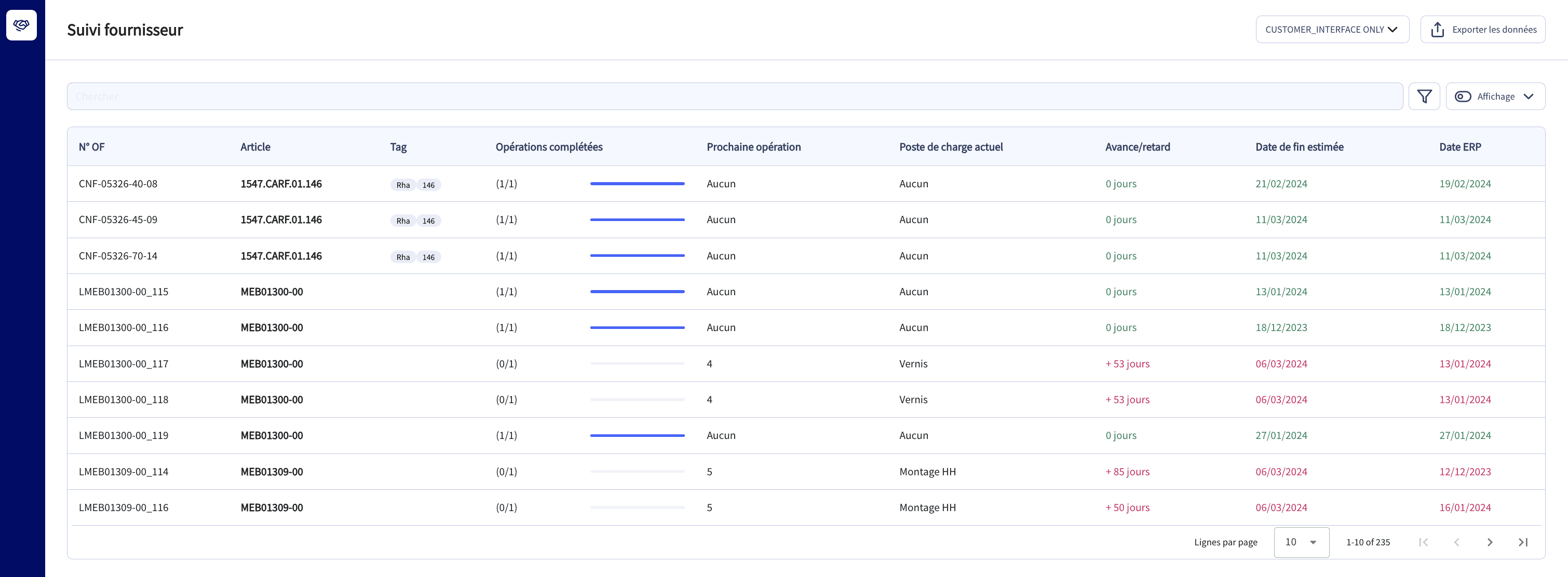
Setting up an online collaborative platform allows customers to track the status of their orders in real time, from production to delivery. Suppliers can share precise information on production lead times, part availability, and order-status updates, which reduces calls and emails to obtain tracking information.
For a scheduler, the relationship with suppliers is essential because a significant part of production operations is often outsourced. Whether for manufacturing specific components, assembling finished products, or providing specialized services, suppliers play a determining role in the value chain. Thus, the reliability, quality, and punctuality of suppliers become key factors for the scheduler in order to guarantee the smooth running of production.
The scheduler faces managing the complexity resulting from the multiplicity of suppliers and the diversity of products to be produced. Coordinating production schedules, delivery times, and technical specifications with different suppliers can become a major challenge. Moreover, order changes, delivery delays, or quality problems at suppliers can lead to disruptions in the scheduler's production plan.
To overcome these challenges, it is essential for the scheduler to cultivate a solid, collaborative relationship with suppliers. This can be done by establishing clear, open communication, sharing relevant information on production forecasts and order changes, and collaborating closely to resolve problems quickly. In addition, the use of technologies such as collaborative platforms making it possible to track the status of orders and the availability of parts in real time can greatly facilitate production planning and strengthen the customer-supplier relationship.
At Oplit, increasing plant productivity is the first battle. Oplit recently developed a customer-supplier interface to enable better visibility and better collaboration between customers and suppliers.
Are you a customer? In one click, you see the progress of your parts in real time.
Are you a supplier? Give your customers access to the data of your choice.
In short, the connectivity of the key players in the supply chain proves essential to optimizing operations and maximizing companies' profitability. By fostering close collaboration between suppliers, customers, and other stakeholders, companies can improve visibility into the logistics chain, reduce inefficiencies, and strengthen their competitive position in the market. Thus, it is imperative that companies invest in solutions and practices that foster increased connectivity within their supply chain, in order to thrive in a constantly evolving business environment.