Solutions

The decisive showdown between two generations of industrial planning
In today's industrial context, marked by unprecedented order volatility, recurring supply disruptions, and the growing complexity of production chains, plant managers and supply chain managers face a major challenge: how can they maintain an optimal service level while keeping their costs and lead times under control?
Scheduling and industrial-planning software has become an indispensable strategic tool. According to a recent study of the APS (Advanced Planning & Scheduling) solutions market, the sector is experiencing exceptional growth with a compound annual growth rate (CAGR) of 16.2% between 2024 and 2030, rising from $701.6 million in 2023 to $1,324.31 million by 2030. This expansion reflects the urgency for manufacturers to equip themselves with high-performing tools.
To meet this need, two solutions stand out on the market: Preactor, now integrated into Siemens Opcenter APS, represents the historic, proven approach to industrial scheduling. On the other side, Oplit embodies the new generation of production software, designed specifically to meet the challenges of modern industry.
But which solution truly addresses today's industrial challenges? Which platform allows planners, schedulers, and production managers to gain in responsiveness, visibility, and performance? That is precisely the question this article will answer.
Preactor (Siemens Opcenter APS): a pioneer of industrial scheduling
A recognized legacy solution
Preactor has established itself since the 1990s as a benchmark in advanced planning and scheduling. Now integrated within the Siemens Opcenter APS suite, this production software built its reputation on its ability to model complex manufacturing environments and generate detailed production schedules.
Preactor's main features include finite-capacity advanced planning, multi-scenario simulation, the management of machine and resource constraints, and the generation of detailed Gantt charts. The solution uses sophisticated algorithms to balance demand and capacity, theoretically making it possible to optimize resource utilization and improve on-time delivery rates.
Siemens Opcenter APS offers several license levels (Standard, Professional, Ultimate) to adapt to the needs of different organizations. Integration with other Siemens systems (MES, ERP, Teamcenter) is also an advantage for companies already committed to the Siemens ecosystem.
The limits of an aging architecture
Despite its reputation, Preactor has significant weaknesses that are becoming increasingly problematic in the current industrial context:
Integration complexity and lack of agility: Preactor's on-premise architecture requires substantial IT resources for installation, configuration, and maintenance. Manufacturers regularly report deployment times exceeding 12 months, with a strong dependence on external integrators. This structural heaviness makes it difficult to adapt to the rapid evolution of business needs.
Dated user interface: Preactor's user experience remains technical and not very intuitive. The learning curve is particularly steep, often requiring several weeks of training to reach an operational level. This complexity creates a dependence on internal experts or external consultants, increasing the organization's costs and risks.
Difficulties in the face of volatility: In an environment where customer priorities change daily, where production contingencies are constant, and where data must be updated in real time, Preactor's architecture shows its limits. The scheduling software struggles to offer the responsiveness needed to quickly recompute schedules and effectively communicate new priorities to the floor.
Maintenance and evolution: Preactor updates generally require heavy IT interventions and can disrupt existing processes. The absence of continuous updates limits the solution's ability to quickly incorporate technological innovations, particularly in artificial intelligence and automation.
As several users point out on review platforms such as Capterra, “Preactor must be customized almost entirely during the implementation phase, which makes that phase critical and requires perfectly defining how the factory operates.”
Oplit: the new generation of intelligent planning
A solution designed for modern manufacturers
Faced with the limits of legacy solutions, Oplit was developed specifically to meet the needs of volatile, multi-site industrial environments. This industrial-planning solution stands out through several major innovations:
Cloud-native architecture: Unlike traditional on-premise solutions, Oplit runs in the cloud, enabling rapid deployment (generally in 10 to 16 weeks versus more than 12 months for Preactor) and continuous updates with no service interruption. This architecture also guarantees excellent scalability to support the growth of organizations.
Native connectors: Oplit includes ready-to-use connectors with the main ERPs (SAP, Oracle, Sage) and MES on the market. This native integration capability drastically reduces implementation costs and times, while ensuring smooth data synchronization between systems.
Dynamic, responsive scheduling: Oplit enables fine-grained scheduling, as close as possible to the shop floor, with precise consideration of machine, operator, tooling, and critical-resource constraints. Each work order is positioned dynamically according to available capacity and business priorities, to guarantee a reliable, realistic execution of the production plan.
Real-time recalculation and contingency management: The Oplit scheduler reacts in real time to production events: supplier delay, machine breakdown, operator absence, the addition of an urgent work order, and so on. Each change automatically triggers a recalculation of the short-term schedule, allowing teams to react immediately without losing control of the flow.
Accessibility without IT dependence: Designed with a no-code approach, Oplit allows business users to configure their own planning and scheduling rules without requiring constant intervention from the IT department. This autonomy considerably accelerates the tool's adaptation to changing processes.
AI as a scheduling copilot
Oplit's major innovation lies in the native integration of industrial artificial intelligence through Oplit Copilot. This feature radically transforms the planner's experience:
Intelligent prediction of completion dates: Oplit Copilot automatically analyzes work orders (WO), detects missing components, tracks production progress (scrap, delays), and accurately predicts actual completion dates. This capability eliminates the uncertainty that often paralyzes customer-supplier relationships.
Rescheduling suggestions: Faced with a production contingency or a new customer emergency, Oplit's AI automatically proposes optimized reschedulings that take all constraints (capacity, skills, priorities) into account. The planner retains final control but benefits from an intelligent assistant that speeds up decision-making.
Automatic bottleneck detection: Oplit Copilot identifies in real time the saturated workstations, abnormal queues, and delay risks. This proactive visibility allows production managers to intervene before problems worsen.
Oplit's approach is clear: AI is not a replacement for the planner but a copilot that augments their capabilities and saves them precious time. The results measured at Oplit's customers speak for themselves: a 30% reduction in production lead times, a 25% reduction in work-in-progress, and a 10% improvement in OEE (Overall Equipment Effectiveness).
A field-centered user experience
Oplit was built around a fundamental principle: an APS software is only effective if it is actually used by all the stakeholders concerned. That is why the interface was designed according to modern user-experience standards:
Intuitive, collaborative interface: Inspired by the best practices of the modern web, Oplit's interface allows for quick adoption. Users report full autonomy in under 2 weeks, versus several months for traditional solutions.
Optimized shop-floor communication: Oplit displays priorities directly at the foot of the machines via connected screens or tablets. Operators see in real time the priority work orders, production targets, and progress. This transparency considerably improves adherence to the plan and reduces conflicts between planning and production.
Supply Chain–Production collaboration: The platform fosters communication between all the departments concerned. Supply chain managers can simulate the impact of new orders, planners adjust orders accordingly, and shop-floor supervisors track execution — all on a single, shared platform.
As Cédric Paris, a production team leader at Nexteam, testifies: “With Oplit, we finally have clear visibility into priorities. The leaders know where to focus, and the operators follow the updated priorities.”
Oplit vs Preactor: the complete comparison
Solutions comparison table
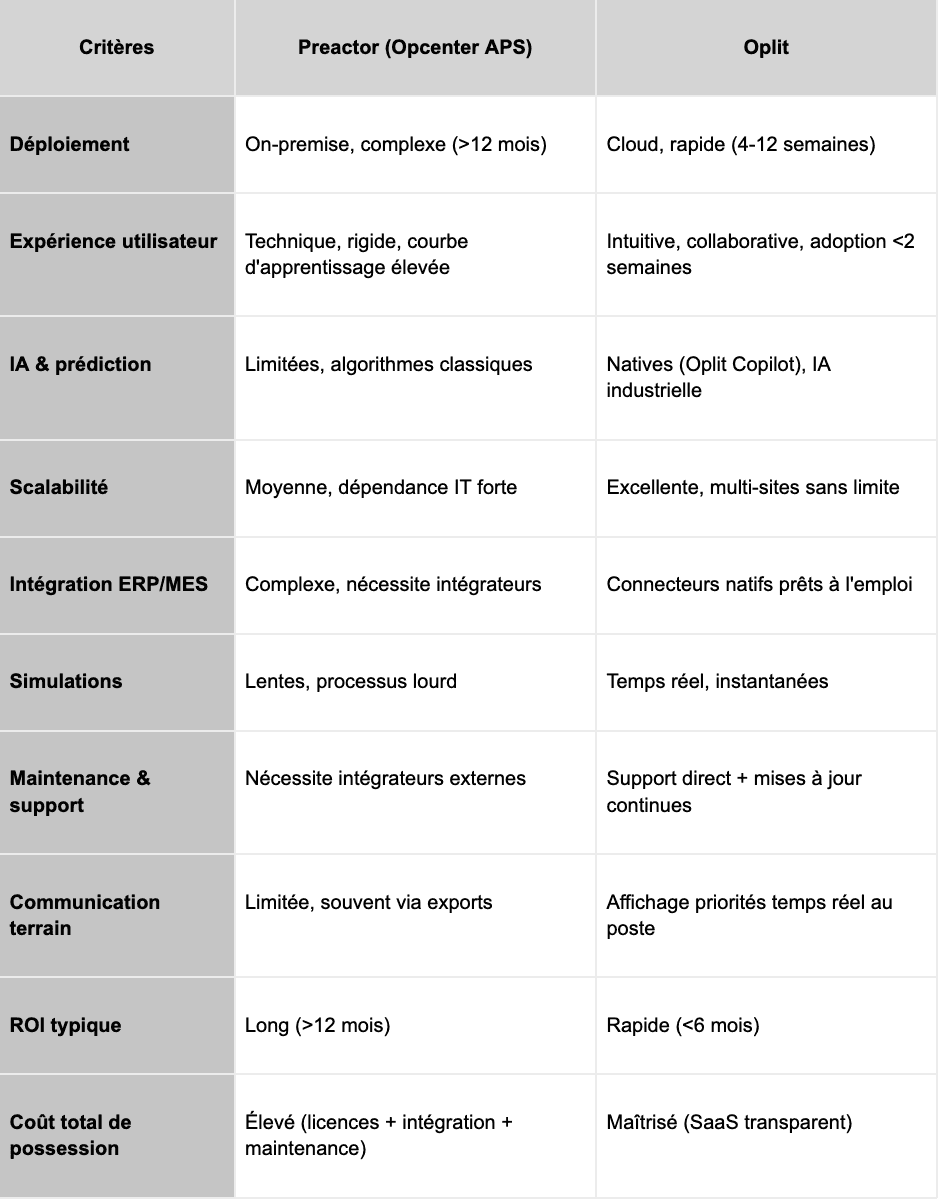
Adaptability and agility challenges in the face of industrial pressures
The 2025 industrial context imposes constraints that did not exist when Preactor was designed in the 1990s:
Complex strategic decisions: Manufacturers must arbitrate daily between inventory levels, product mix, and customer allocation. These decisions require fast, accurate simulations — a capability where Oplit excels thanks to its real-time engine.
Pressure on the customer side: Forecasts are increasingly imprecise and lead times increasingly short. Customers demand immediate answers on delivery dates. Oplit makes it possible to respond instantly thanks to its AI prediction algorithms.
Supplier constraints: Production delays and quality problems at suppliers create constant contingencies. Oplit automatically detects missing components and adjusts schedules accordingly.
Internal contingencies: Machine breakdowns, turnover, absenteeism, and so on. These unforeseen events require frequent reschedulings. Where Preactor requires several hours of manual recalculation, Oplit proposes alternatives in a few seconds.
Oplit also evolves continuously: with bi-weekly updates and a roadmap co-built with customers, the solution constantly adapts to the emerging needs of the industry.
Why Oplit is better suited to the supply chain of today and tomorrow
An answer to the concrete challenges of industry
The pain points identified by plant managers and supply chain managers find direct answers in Oplit:
Poor resource allocation: Oplit offers complete visibility into operator load and availability, making it possible to add shifts and temporary staff at the right time, based on real data rather than estimates.
Time-consuming planning: Where planners used to spend 4 hours a day consolidating data in Excel and PowerPoint, Oplit automates these repetitive tasks, freeing up time for analysis and decision-making.
Lack of standardization: Oplit makes it possible to have a consolidated view at the group level, with standardized but configurable processes per site. Onboarding a new planner goes from 2 weeks to a few days.
Unclear priorities: Thanks to the real-time display of priorities at the foot of the machines, operators always know what to work on. Automatic prioritization based on business rules eliminates ambiguity.
No visibility into completion dates: Oplit Copilot accurately projects the completion dates of work orders, making it possible to respond instantly to customers and drastically reduce follow-up requests.
Difficulty analyzing variances: Oplit's analytics dashboards automatically consolidate incidents, delays, and variances from targets, enabling fine-grained analysis and the identification of root causes.
How to migrate from Preactor to Oplit?
A transition without disruption
The prospect of changing production software can seem intimidating, but Oplit has developed a proven migration process:
Smooth transfer of historical data: Routing data, bills of materials, production history, and scheduling rules can be imported into Oplit. This continuity makes it possible to benefit immediately from accumulated experience.
Structured support: The Oplit implementation process follows a proven 3-phase methodology:
Weeks 1-2: Mapping of the target process, alignment on priorities, setup of the first version
Weeks 3-12: Recurring use of Oplit, product iterations, process validation, training of all users
Weeks 13-14: Path to autonomy, validation of project success, preparation of the extended rollout
From week 12: Continuous improvement, sharing of best practices, monthly meetings and semi-annual steering committees
Temporary coexistence possible: If necessary, Oplit can temporarily coexist with Preactor while the new solution is validated on a pilot scope before full rollout.
ROI and first measurable results
One of Oplit's major advantages over Preactor lies in the speed at which results are obtained:
Gains from the first 3 months:
Increased responsiveness: Planners can adjust schedules several times a day instead of once a week
Improved visibility: All stakeholders see the same information in real time
Schedule reliability: The announced dates are met more systematically
Typical ROI in under 6 months: Unlike Preactor, where ROI generally exceeds 12 months (or even 18-24 months with integration costs), Oplit demonstrates a rapid return on investment thanks to:
Controlled deployment costs (no expensive external integrators)
Immediate productivity gains (a 30 to 50% reduction in planning time)
Improved service level (OTD +10 to 15%)
Reduced inventory and work-in-progress (WIP -20 to 30%)
Transparent business model: Oplit operates on a SaaS model with clear, predictable pricing that includes support, updates, and hosting. This transparency contrasts with Preactor's on-premise model, where hidden costs (infrastructure, maintenance, version upgrades) can add up.
Conclusion: entering the era of augmented planning
The comparison between Oplit and Preactor (Siemens Opcenter APS) highlights a paradigm shift in the approach to industrial planning and scheduling.
Preactor has undeniably paved the way for APS (Advanced Planning & Scheduling) solutions and remains a viable option for stable, highly standardized industrial environments that are already deeply rooted in the Siemens ecosystem. However, its aging architecture, its implementation complexity, and its lack of agility in the face of modern challenges make it an increasingly poorly suited solution for the industrial realities of 2025.
Oplit, on the contrary, embodies the new generation of scheduling software: designed for volatility, powered by artificial intelligence, centered on the user experience, and able to adapt continuously to changing business needs. Its rapid deployment, accelerated ROI, and measurable results at customers of all sizes and in all sectors make it the benchmark solution for plant managers, planners, and supply chain managers who want to transform their operational performance.
In a context where every day counts, where contingencies are constant, and where responsiveness makes the difference between commercial success and failure, choosing the right industrial-planning solution is not an option: it is a strategic imperative.
Forward-thinking manufacturers have already made their choice. What about you?
Ready to discover how Oplit can transform your planning and scheduling?
👉 Request a personalized Oplit demo and discover in a few minutes how to gain in responsiveness, visibility, and performance.