Solutions

In an industrial context marked by growing demand volatility, frequent supply disruptions, and intensified customer pressure, plant managers and production managers face a major challenge: maintaining their service level while optimizing their resources and actual capacity. Between schedules that are obsolete as soon as they are created, time-consuming Excel files, and ineffective meetings that do not allow for real-time decision-making, the question of choosing the right scheduling software has never been so crucial.
Two solutions stand out in the APS (Advanced Planning and Scheduling) software market: Delmia Ortems, a long-standing player integrated into the Dassault Systèmes ecosystem, and Oplit, a new-generation solution designed for the responsiveness and agility of modern shops. This APS software comparison aims to enlighten industrial decision-makers on the strengths and limits of each approach.
In this article, we will analyze Oplit vs Delmia Ortems in depth to determine which solution best meets the challenges of today's advanced industrial planning: responsiveness to contingencies, accuracy of delivery dates, supply chain–production collaboration, and adaptation to the growing complexity of product mixes.
Delmia Ortems: a long-standing player in industrial planning
Origin and positioning within the Dassault Systèmes ecosystem
Delmia Ortems is a planning and scheduling solution deployed for more than 20 years, acquired by Dassault Systèmes to strengthen its Manufacturing Operations Management offering. Integrated into the 3DEXPERIENCE suite, this APS solution is aimed mainly at large industrial groups with complex production processes, particularly in the aerospace, automotive, and capital-goods sectors.
According to the information available on the Dassault Systèmes website, Ortems has more than 16,000 users across more than 60 countries, which reflects its long-standing presence in the scheduling software market.
The recognized strengths of Delmia Ortems
Delmia Ortems offers advanced finite-capacity optimization capabilities, making it possible to manage multi-level constraints: complex bills of materials, machine, material, labor, and tooling constraints. The solution also makes it possible to run scenario simulations to compare different planning options.
Delmia Ortems's features include:
Short-, medium-, and long-term planning: from S&OP (Sales & Operations Planning) to the MPS (Master Production Schedule) and on to detailed scheduling
Resource optimization: bottleneck management and flow synchronization
ERP integration: connectors with the main ERPs on the market (SAP, Oracle, etc.)
Campaign management: optimization of runs and format changeovers
According to a publication by Visiativ, a long-standing Delmia Ortems partner, companies that have implemented this solution have observed reductions in production lead times of 20 to 40%.
The limits in the current industrial context
Despite its undeniable strengths, Delmia Ortems has significant limitations in the face of the realities of Industry 4.0:
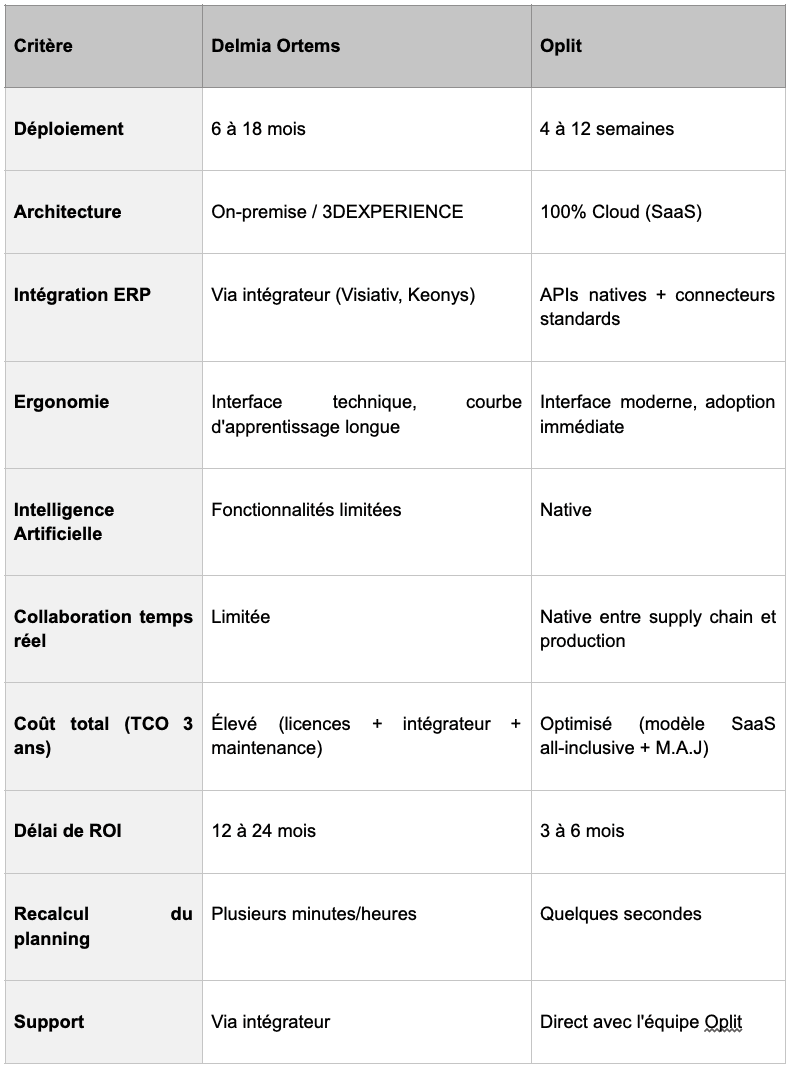
1. Long, costly deployment. Implementing Delmia Ortems generally requires several months of work, with a strong dependence on integrators (Visiativ, Keonys, D4M, Createch). Projects often span 6 to 18 months, mobilizing substantial IT resources and generating high consulting costs.
2. An interface that is not very intuitive for the field. Initially designed for planning engineers, the Delmia Ortems interface is often perceived as technical and rigid by operational users. Shop-floor supervisors and schedulers regularly express difficulties in adopting it, requiring long, repeated training.
3. Limited real-time recalculation capability. The structure of Delmia Ortems, inherited from an on-premise architecture, limits the ability to instantly recompute a complete schedule following a contingency. Recalculations can take several minutes or even hours for complex schedules, which reduces responsiveness to daily emergencies: machine breakdowns, supplier delays, unplanned absences.
4. Limited management of volatility. In an environment where customer forecasts are inaccurate, where short lead times prevail, and where stockouts are frequent, Delmia Ortems struggles to offer the necessary flexibility. The solution was designed for more stable industrial environments, with master schedules frozen over several weeks.
Oplit: the new-generation solution for advanced industrial planning
Origin and product vision
Oplit was founded in 2020 by Thibaut Wilhelm and Soufiane Lamrissi, two entrepreneurs from the industrial world and backed by OSS Ventures, a studio specialized in manufacturing. Unlike legacy solutions, Oplit was not designed as a complex mathematical optimization tool, but as a real-time management platform conceived for the realities of the field.
Oplit's vision rests on a simple observation: in a context of extreme volatility (supply chain tensions, high turnover, customer pressure), manufacturers need tools that recompute continuously, automatically detect problems, and enable native collaboration between the supply chain and production.
By way of example, the solution is deployed across more than 100 industrial sites in 12 countries. Among the results observed at some customers: +15% in service level (OTD) in aerospace, -20% in lead time in watchmaking, and -6 hours a week of time spent by planners.
A modern architecture suited to Industry 4.0
Oplit stands out for its 100% cloud and real-time architecture, offering several structural advantages:
1. Rapid integration with ERPs and MES. Unlike Delmia Ortems, which requires heavy connectors developed by integrators, Oplit offers native APIs and standard connectors for rapid integration with the main ERPs on the market, notably SAP, Infor, or Sage. Data flows are bidirectional and event-driven, ensuring continuous synchronization with the information system.
2. Continuous software updates. As a SaaS solution, Oplit benefits from frequent enhancements, with two major features deployed each month, without requiring a costly IT project. This product approach guarantees ongoing evolution based on user feedback.
3. SOC2 Type 2 certification. Oplit is SOC2 Type 2 certified, a security standard developed by the American Institute of Certified Public Accountants, guaranteeing optimal protection of sensitive industrial data.
The power of Oplit Copilot: AI serving planning
One of Oplit's major differentiators lies in its integrated artificial-intelligence engine, Oplit Copilot, which offers unprecedented features:
1. Automatic prediction of completion dates. By analyzing historical performance, actual scrap rates, observed setup times, and work-in-progress levels, Oplit Copilot computes in real time a forecast completion date for each work order. This feature allows order-management teams to communicate reliable lead times to customers.
2. Automatic rescheduling suggestions. Faced with a contingency (machine breakdown, supplier delay, customer emergency), Oplit Copilot automatically proposes several optimized rescheduling scenarios, allowing the planner to make an informed decision in a few seconds rather than several hours.
3. Dynamic bottleneck detection. The system continuously analyzes the load levels of each workstation and automatically identifies the current and future bottleneck stations, enabling proactive anticipation of capacity problems.
4. Intelligent prioritization of work orders. Based on the defined production objectives (OTD, inventory reduction, OEE optimization), Oplit's AI automatically computes the optimal priorities and transmits them in real time to operators via shop-floor screens.
Oplit vs Delmia Ortems: the complete comparison
Summary comparison table:
Adapting to production contingencies: a major challenge
One of the most discriminating criteria in the APS software comparison concerns the ability to manage daily contingencies.
Delmia Ortems relies on a frozen-schedule logic: an optimal plan is built at a given moment, then updated manually during planning meetings (generally weekly). Between two updates, gaps accumulate, priorities become obsolete, and operators no longer know which task to perform first.
Oplit, on the contrary, operates on continuous recalculation: each event (production completion, declared delay, customer emergency) automatically triggers an update of the complete plan in a few seconds. The priorities displayed at the workstations are always up to date, guaranteeing that each operator works on the right part at the right time.
This fundamental difference explains why companies using Oplit observe a significant reduction in work-in-progress and an improvement in service level: the plan remains permanently aligned with the reality on the floor.
Responsiveness to customer emergencies
When a customer calls to request an urgent delivery or an earlier date, the ability to assess the impact and recompute the schedule becomes critical.
With Delmia Ortems, this analysis generally requires:
Extracting the current data
Recomputing the complete schedule (a lengthy process)
Manually analyzing the impacts
Making a decision
Communicating the new priorities
This process can take several hours, during which production continues on the old plan, potentially worsening the situation.
With Oplit, the process is radically different:
The planner changes the priority in the interface
Oplit Copilot recomputes the entire plan in a few seconds
The impacts are visualized immediately (affected completion dates, overloaded stations)
The new priorities are transmitted instantly to the shop-floor screens
This responsiveness transforms the customer relationship: instead of saying “I'll call you back tomorrow,” the order-management manager can confirm (or not) feasibility during the phone call.
Compatibility with the new challenges of Industry 4.0
Today's manufacturers face unprecedented challenges that require suitable tools:
1. An increasingly complex product mix. Customers demand customized products in small runs, multiplying the number of references to manage. Oplit excels in this context thanks to its ability to manage thousands of work orders simultaneously with dynamic priorities.
2. High supply variability. Supplier shortages and delivery delays have become the norm. Oplit natively incorporates supply-constraint management and automatically recomputes schedules according to the materials actually available.
3. Multi-site management. Many industrial groups must coordinate production across several sites. Oplit offers a consolidated load/capacity view across sites, making it possible to optimize the allocation of orders between plants.
4. Alignment of industrial, supply chain, and financial objectives. Oplit makes it possible to define quantified objectives (reducing inventory by X%, improving OTD by Y points) and to track the achievement of these objectives in real time, with variance analysis and action plans.
Why Oplit is better suited to today's industry (and tomorrow's)
Industry has changed: legacy APS solutions struggle to keep up
The industrial context of 2025 bears no resemblance to that of the 2000s, the period during which Delmia Ortems was designed:
1. Unpredictable demand. Sales forecasts have become much less reliable, with significant weekly variations. Manufacturers must be able to reschedule quickly rather than rely on frozen plans.
2. High turnover rate. In many sectors, turnover reaches 20 to 30% per year. Training new planners on complex tools like Delmia Ortems takes several weeks, whereas Oplit allows for adoption in a few days thanks to its intuitive interface.
3. Frequent shortages. Tensions on supply chains require near-daily schedule recalculations. Oplit handles these recalculations automatically, where Delmia Ortems requires manual intervention.
4. Customer pressure on lead times. Customers demand reliable delivery dates and proactive communication in case of delay. Oplit provides forecast dates in real time, allowing sales teams to respond immediately to requests.
Oplit: designed for volatility
Oplit was conceived from the outset for a volatile and unpredictable industrial world:
1. Predictive model and continuous simulation. Rather than computing an optimal plan and then observing the gaps, Oplit continuously simulates the future evolution of production and proactively alerts on risks (stations that are going to saturate, work orders that are going to fall behind, stocks that are going to run short).
2. Native supply chain / production / shop-floor collaboration. The three key players (supply chain planning, production managers, field operators) work in the same tool with views adapted to their needs. No more Excel files circulating by email and conflicting priorities.
3. Unified real-time load/capacity view. Oplit offers a consolidated view of load and capacity at different granularities (day, week, month) and makes it possible to simulate in one click the impact of a new order or a machine investment.
Feedback from industrial sites
Beyond the figures, the testimonials of Oplit users are telling:
Cédric Paris, Production Team Leader at LISI Aerospace (10,000 employees): “With Oplit, we finally have clear visibility into priorities. The leaders know where to focus their efforts, and the operators follow priorities updated in real time.”
Nathalie Machere, Supply Chain Manager at Nexteam (5,000 employees): “Our supply chain reacts faster than ever: no more repetitive data entry, everything is automated, and the constraints are managed intelligently.”
Jérémy Romier, Operations Director at Vaucher (200 employees, luxury watchmaking): “As Operations Director, I can finally align the teams on priorities, reduce emergency interventions on the floor, and make decisions based on real-time data.”
Yannick Duclot, Supply Chain Director (luxury leather goods, 120 employees): “We trust our production targets again — we can anticipate challenges, overcome them, and rely on realistic, achievable plans.”
This feedback highlights an essential point: Oplit does not merely optimize mathematically, it transforms the way industrial teams work.
Case study: why some sites migrate from Delmia Ortems to Oplit
Initial issues encountered with Delmia Ortems
Several companies that had initially deployed Delmia Ortems ultimately chose to migrate to Oplit. The reasons given are recurring:
1. Projects that are too heavy and complex. Delmia Ortems projects often drag on beyond the planned deadlines, with complex configuration phases requiring the continuous intervention of external integrators. The initially budgeted costs are frequently exceeded.
2. Difficult adaptation to the reality on the floor. Once deployed, Delmia Ortems generates theoretically optimal plans that are often disconnected from the actual operational constraints. Planners spend their time manually “correcting” the plan proposed by the system.
3. Dependence on integrators. Any change in configuration or evolution of the system requires the intervention of an integrator, generating recurring delays and costs. This dependence limits the autonomy of internal teams.
Gains brought by Oplit after migration
The sites that have migrated to Oplit report significant improvements:
1. Massive reduction in planning time. Planners save between 5 and 10 hours a week, time previously spent manually updating schedules and preparing meetings.
2. Better Supply Chain / Production communication. Oplit's collaborative platform eliminates the silos between departments. The supply chain and production teams work on the same data, in real time, drastically reducing misunderstandings and priority conflicts.
3. Improved accuracy of reliable dates. Thanks to Oplit Copilot's predictive capabilities, sales teams can communicate reliable delivery dates to customers, reducing follow-ups and improving customer satisfaction.
How to migrate from Delmia Ortems to Oplit?
A gradual, secure migration
For companies currently using Delmia Ortems, the migration to Oplit can be carried out gradually and without disruption:
Phase 1: Audit and scoping (2 weeks)
Analysis of current processes and pain points
Mapping of data flows between Delmia Ortems and the ERP
Definition of priorities and success indicators
Phase 2: First version of Oplit (2 weeks)
Initial configuration of the platform
Integration with the existing ERP via APIs
Automatic import of routings, work orders, and resources
Training of the key users
Phase 3: Parallel run (4 weeks)
Simultaneous use of Delmia Ortems and Oplit in parallel
Comparison of results and gradual adjustments
Upskilling of the teams
Phase 4: Full switchover (2 weeks)
Gradual shutdown of Delmia Ortems
Validation of project success
Empowerment of the teams
Total duration: 10 to 12 weeks, versus 6 to 18 months for an initial Delmia Ortems project.
Fast training and immediate adoption
One of Oplit's major strengths lies in its ease of use. Unlike Delmia Ortems, which requires several weeks of training, Oplit allows for operational adoption in a few days:
Intuitive interface inspired by modern web standards
Step-by-step guided processes
Expert Oplit support available continuously
Detailed knowledge base and FAQ
A user community to share best practices
Conclusion: which solution should you choose for your industrial planning?
The Oplit vs Delmia Ortems comparison reveals two radically different philosophies:
Delmia Ortems is a powerful, comprehensive solution, designed for stable industrial environments with substantial IT resources and long-term transformation projects. It is aimed at large industrial groups seeking deep integration with Dassault Systèmes's 3DEXPERIENCE suite and with the means necessary for complex deployments.
Oplit, on the contrary, was designed for modern industry characterized by volatility, uncertainty, and the need for responsiveness. Its strength lies in its ability to adapt in real time to contingencies, to provide instant visibility into the production situation, and to enable smooth collaboration between all the players.
For plant managers, supply chain managers, planners, and schedulers who face the following challenges daily:
Poor resource allocation (poorly anticipated loads, temporary staff added at the wrong time)
Time-consuming planning (hours spent on Excel and PowerPoint)
Lack of visibility into completion dates and priorities
Ineffective meetings with no decision-making
Frequent variances from production targets
Oplit emerges as the most suitable solution, offering:
A rapid deployment (4 to 12 weeks)
A measurable ROI in 3 to 6 months
Tangible gains on OEE, OTD, and lead times
Restored autonomy for the teams
Real-time visibility across the entire value chain
In a context where industrial competitiveness hinges on the ability to react quickly and keep your commitments to customers, choosing the right scheduling software is no longer an option but a strategic necessity.
Oplit represents this new generation of APS: agile, collaborative, intelligent, and designed for the challenges of Industry 4.0. For manufacturers looking to improve their advanced industrial planning, reduce their work-in-progress, make their lead times reliable, and optimize the use of their resources, Oplit vs Delmia Ortems is not a difficult choice: it is an obvious one.
👉 Request a personalized Oplit demo based on your real data
👉 Discover our customer case studies in your industrial sector