Best practices
Understanding the mechanics of MPM
The Metra Potential Method was developed in France in the 1970s; it makes it possible to determine the minimum duration of a project and the dates at which the different tasks of a project can or must start so that this minimum duration is respected.
A method developed in France in the 1970s, MPM makes it possible to determine the minimum duration of a project and the dates at which the different tasks of a project can or must start so that this minimum duration is respected.
This planning method is suited to project-based production (such as buildings, construction sites...) that lasts several years, or even over a few months.
In order to understand the mechanics of MPM, let's take a simplified example, a project that requires carrying out 5 tasks.
Some tasks require other tasks to be completed in order to be carried out.

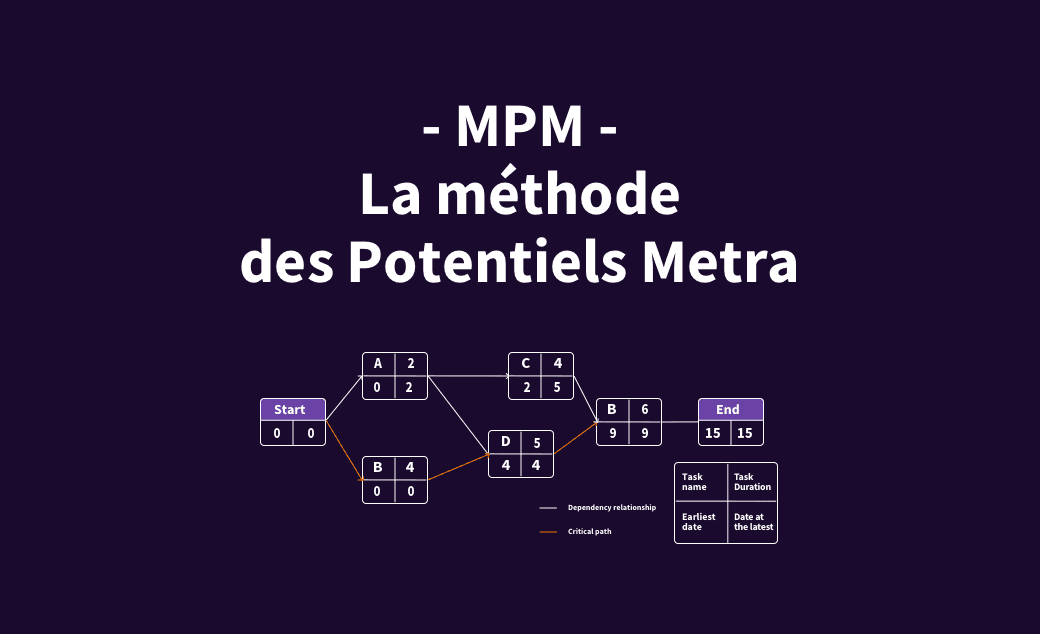
When we integrate this information into an MPM model, we obtain the graph below:

At the start date, two tasks can be launched simultaneously (A and B). Task C requires the completion of task A. And task D requires the completion of tasks A and B.
Task A requires 2 units of time (days in our example) to be completed, while task B requires 4 days. Thus, task D cannot start before 4 days.
Once this logic is integrated, we can determine a critical path (indicated in red on the graph) that represents the longest sequence of tasks between the start and the end of the project. It corresponds to the incompressible completion time of the project.
Although this example is simplified, in reality, MPM graphs can contain hundreds of different tasks and span several months, or even years.
Generally speaking, it is always true that a graph has a start date and an end date. Between these two dates, each task is represented by a node.
For each task, we know its duration and its start date (earliest and latest).
The graph is read from left to right, and the succession constraints between the tasks are symbolized by arrows (called arcs) that symbolize the precedence relationships of the tasks.
From this graph, we can determine the critical path of the project, which corresponds to the longest sequence of tasks between the start and the end of the project.
The MPM method makes it possible to have a visual representation of the project's organization and to quickly know its incompressible duration.