Best practices
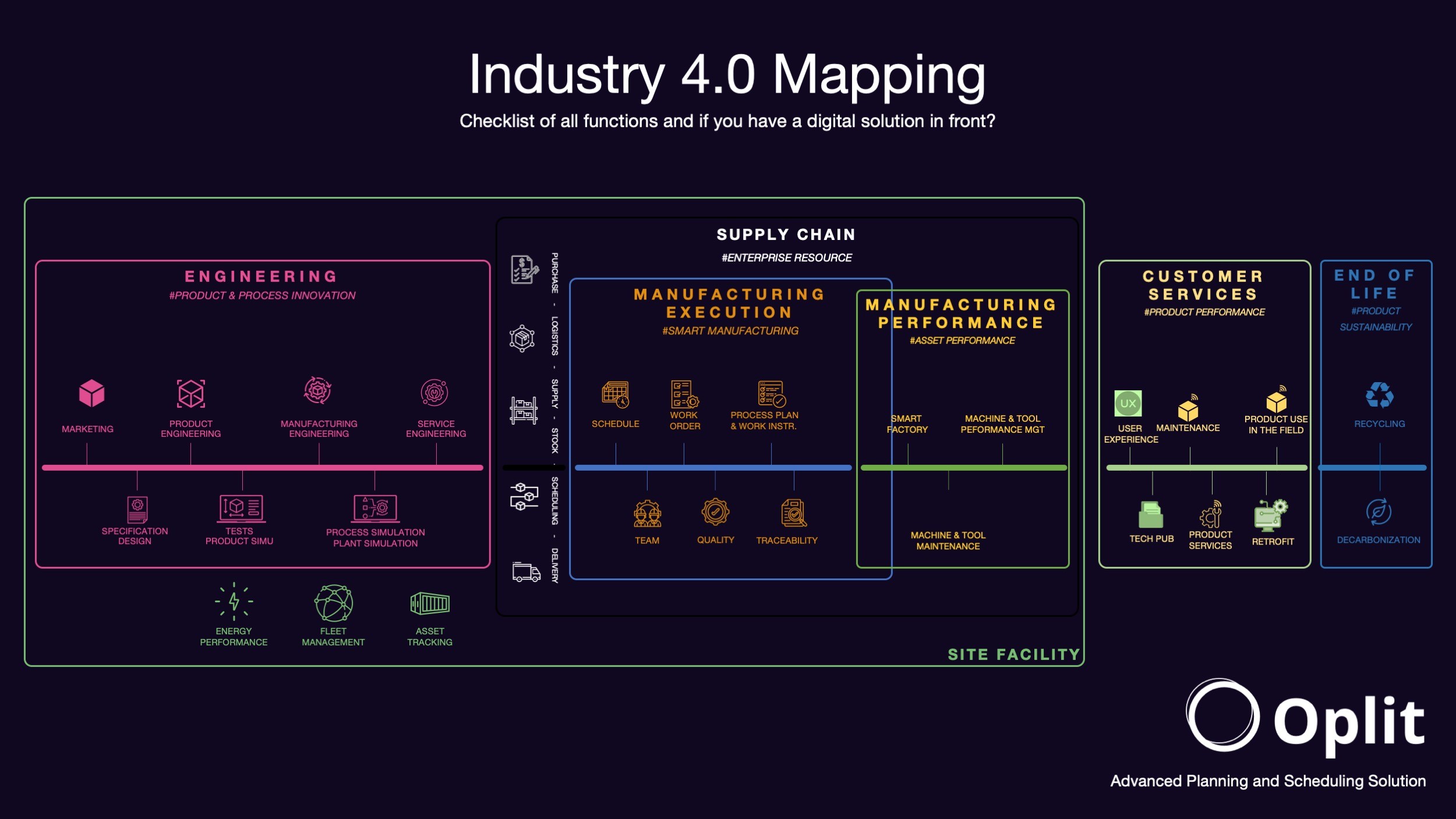
The fundamental role of the ERP: the cornerstone of digitalization
The industrial ecosystem: a digital solution for every function
A closer look at scheduling and planning software: is it worth digitalizing?
Checklist for a successful digitalization of your Industry 4.0 plant
In a world where Industry 4.0 is redefining the standards of productivity, mapping digital tools in production has become a strategic lever. From data management with ERPs to industry-specific scheduling software, each tool plays an essential role in optimizing processes, gaining flexibility, and improving overall performance. But how do you know whether your functions are well equipped? And what are the consequences if they are not? This article details everything you need to know to structure your digitalization effectively.
The shift toward smart production is not limited to acquiring new technologies. It involves a global vision: every function in your plant must be equipped with suitable digital tools that communicate with one another. Yet many companies hesitate to digitalize certain key steps, such as planning or scheduling. This lack of adequate equipment can lead to inefficiencies, extra costs, or delays in the production chain. This guide will allow you to:
Understand the central role of digital tools in production.
Identify the technological solutions suited to each function.
Carry out an effective mapping of digital tools to avoid the pitfalls of non-digitalization.
Any industrial digitalization project begins with the implementation of an ERP (Enterprise Resource Planning). A true foundation, the ERP centralizes and structures the data from the plant's different functions, such as orders, stock, or financial flows. Here is why an ERP is indispensable:
Data centralization: All critical information is unified in a single system.
Interoperability: The ERP feeds data to the other software in the industrial ecosystem (planning, scheduling, production).
Increased traceability: Precise tracking of production movements and logistics flows.
To digitalize a plant effectively, it is crucial to identify the key functions and the digital tools dedicated to them. Here is a function-by-function mapping:
Engineering (R&D and product design)
Computer-aided design (CAD) or product lifecycle management (PLM) software allows engineers to design products faster while reducing errors.
Examples of software:
AutoCAD
SolidWorks
CATIA
Expected result:
Reduced time to market
Better management of product iterations and revisions
Improved collaboration between the design and production teams
Operational advantages:
Reduction of design errors and unnecessary iterations
Optimization of the costs linked to prototypes and physical tests
Improved communication between design offices and production
Consequences without digitalization:
Design errors that can impact production and cause delays
Extra costs due to late changes in the production phase
Lack of coordination between teams
KPIs to track:
Average design time per product
Number of changes after prototype validation
Development cost per project
Success indicators:
Reduction in time to production
Reduction in prototyping costs
Improvement in the conformity rate of first production runs
Supply chain (flows and organization)
Production planning
Advanced planning solutions (APS) calculate the best production sequences to maximize resource use.
Examples of software:
Quintiq
Kinaxis
PlanetTogether
Expected result:
Optimization of production capacities and resources
Reduction in delivery times
Reduction of unnecessary stock
Operational advantages:
Better synchronization between customer demand and production capacity
Reduction of the costs linked to overstock or stockouts
Reduction of transport costs thanks to better planning
Consequences without digitalization:
Difficulty adjusting production in the event of demand variations
Increased risk of overstock or stockout
Loss of competitiveness against more agile companies
KPIs to track:
On-time delivery rate
Stock turnover rate
Just-in-time production rate
Success indicators:
Optimized production capacity
Improved customer service level
Reduction in storage costs
Scheduling
Industrial scheduling software is specially designed to plan short-term operations in detail. These tools precisely define "what to produce," "when," and "with which resources."
Examples of software:
Ortems
Preactor
Oplit
Expected result:
Optimized planning of production resources
Reduction of machine waiting and idle times
Improved on-time delivery
Operational advantages:
Reduction of downtime on the production lines
Better management of emergencies and priorities
Optimization of the equipment utilization rate
Consequences without digitalization:
Frequent delays in production schedules
Risk of under-loading or overloading resources
Difficulty reacting to the unexpected and to urgent requests
KPIs to track:
Machine occupancy rate
Percentage of work orders delivered on time
Number of manual adjustments in the schedule
Success indicators:
Improved adherence to production deadlines
Reduction of the costs linked to contingencies and readjustments
Increased flexibility in the face of demand changes
Purchasing and procurement
Software dedicated to purchasing allows fine management of supplier relationships and contracts while optimizing costs.
Examples of software:
SAP Ariba
Ivalua
Coupa
Expected result:
Reduction in procurement costs
Improvement in the delivery times of raw materials
Centralization and automation of the purchasing processes
Operational advantages:
Easier negotiation thanks to the analysis of prices and purchase volumes
Reduction of errors and duplicates in orders
Better management of supplier relationships and contracts
Consequences without digitalization:
Wasted time in the manual management of purchasing
Increased risk of supply disruption
Difficulty negotiating competitive prices for lack of consolidated data
KPIs to track:
Conformity rate of supplier orders
Average acquisition cost per unit produced
Processing time of purchase orders
Success indicators:
Reduction in the cost of raw materials
Improvement in the supplier service level
Reduction in the number of disputes with suppliers
Production: monitoring and performance
Production monitoring is often handled by MES (Manufacturing Execution Systems). These solutions make it possible to monitor the performance of each machine and operator in real time.
Examples of software:
Wonderware (AVEVA)
Siemens Opcenter
Rockwell FactoryTalk
Expected result:
Improvement in the efficiency of the manufacturing processes
Reduction of unplanned stoppages and breakdowns
Optimization of the plant's overall output
Operational advantages:
Immediate identification of bottlenecks
Real-time tracking of machine and operator performance
Anticipation of maintenance to avoid production stoppages
Consequences without digitalization:
Difficulty quickly identifying and resolving production problems
High risk of extra costs linked to unplanned stoppages
Decline in productivity and margins
KPIs to track:
Overall Equipment Effectiveness (OEE)
Number of unplanned machine stoppages
Equipment utilization rate
Success indicators:
Increase in OEE
Reduction in the number of production interruptions
Improvement in production capacity with no additional equipment investment
Why digitalize scheduling?
Planning and scheduling are the nerve center of production. Without suitable tools, plants risk suffering:
Bottlenecks, which slow down production.
Poor priority management.
Financial losses linked to delivery delays.
Excessively high stock levels and a poor working-capital requirement.
With an industrial scheduling software, the supply and production teams react more quickly, make better decisions, and communicate more effectively. In addition, resource allocation is optimized thanks to powerful algorithms.
How do you assess the success of digitalization?
Key questions to ask:
Can I easily adjust my production in the event of a demand peak?
Are my machines used to their full potential?
Can I simulate scenarios to avoid resource conflicts?
Is the time spent on scheduling optimized?
Are the production priorities clear to everyone?
Positive answers to these questions confirm a successful digitalization.
To assess whether your plant is ready to integrate digital tools, follow this checklist:
Do you have a solid ERP?
Do your critical functions (planning, scheduling, production) use dedicated software solutions?
Have you identified the KPIs to monitor to assess performance?
Is interoperability between your tools ensured?
A checklist like this one can serve as a roadmap for modernizing your industrial processes.
Mapping digital tools in production is not just a trend; it is a necessity in a constantly evolving industrial world. Every function in your plant, from engineering to production, benefits from specific digital solutions that increase efficiency and reduce errors. The central role of the ERP, combined with high-performing scheduling software, ensures optimized management of resources and flows. If your company has not yet fully committed to this path, it is time to take concrete steps. Calling on industrial-digitalization experts, like those at Oplit, can help you succeed in this strategic transition.