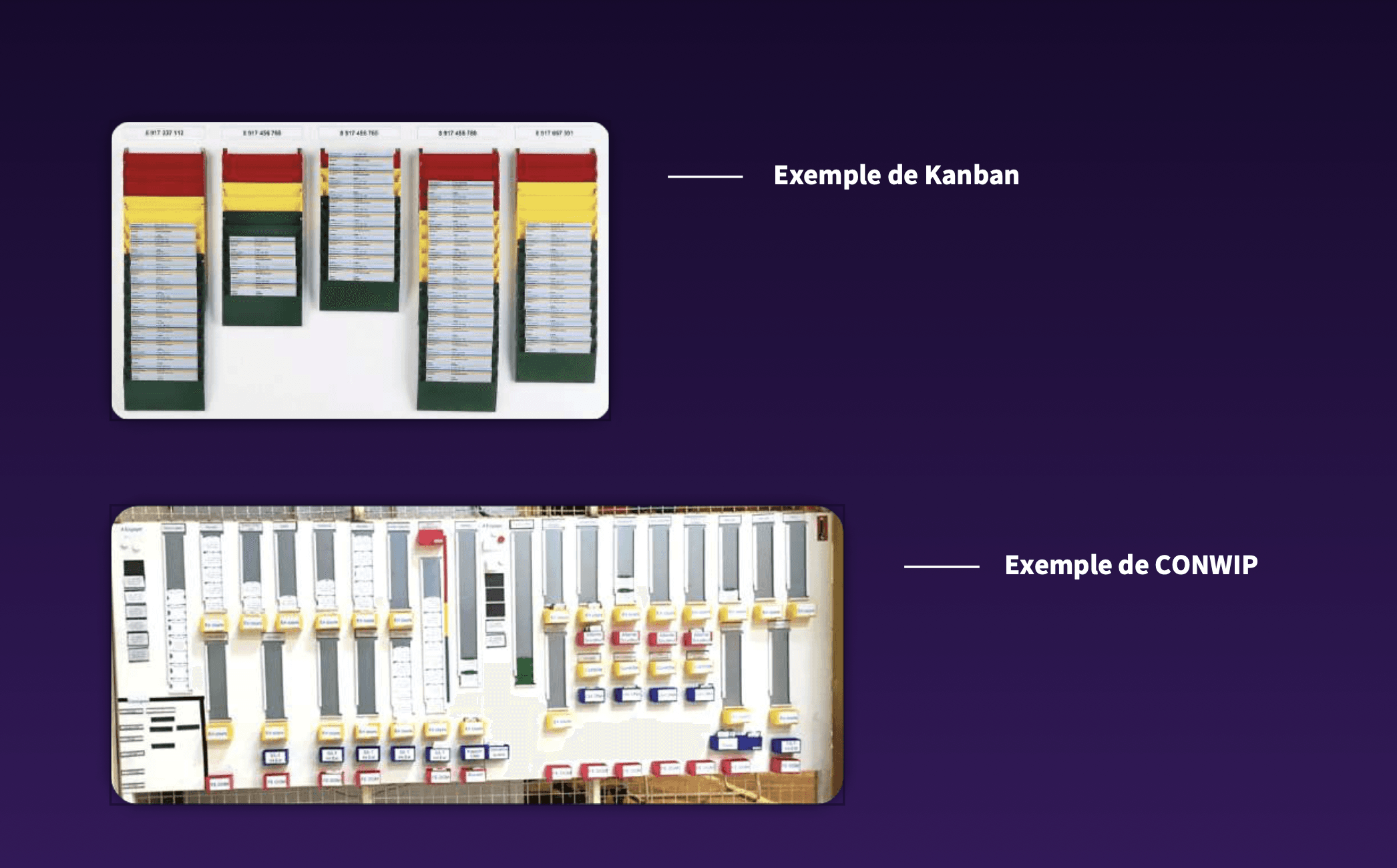
Best practices
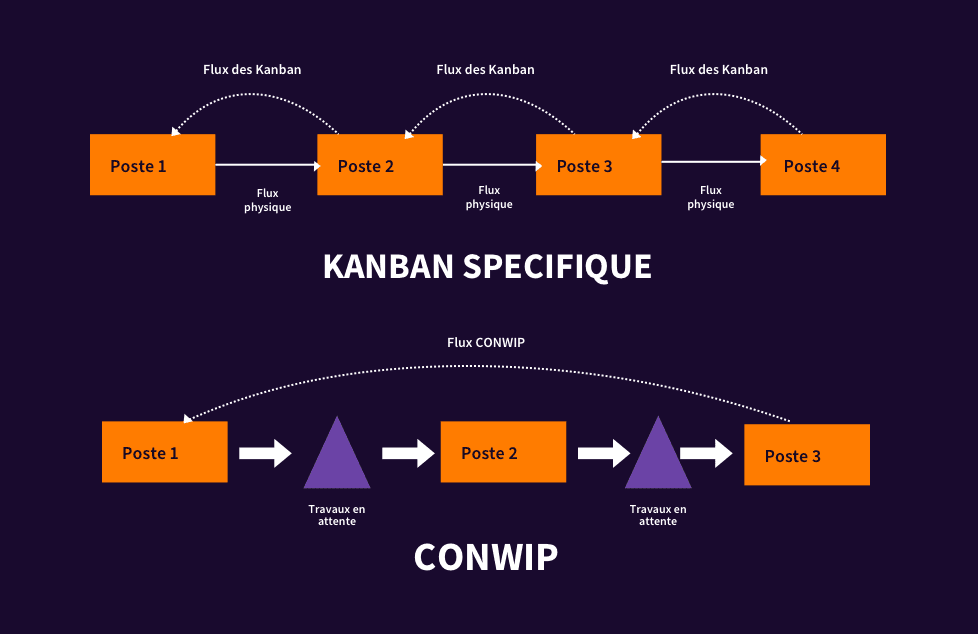
The Kanban method
How do you determine which work order to carry out first?
The CONWIP method
The advantages of the Kanban and CONWIP methods
Two popular flow-management methods in industry, but how exactly do they work and what are their advantages?
The Kanban system was theorized by Taiichi Ohno for Toyota. The goal was to allow the Japanese company to compete with the American carmakers.
The engineer starts from an observation of American supermarkets. He notes that each product has a specific place in the store and is replenished only when the product is bought. He extends this model to industry by imagining the kanban system, which makes it possible to limit the space allocated to each specific component in the factory.
We consider a factory made up of production lines where the workstations are arranged one after the other so that the production flow is linear.
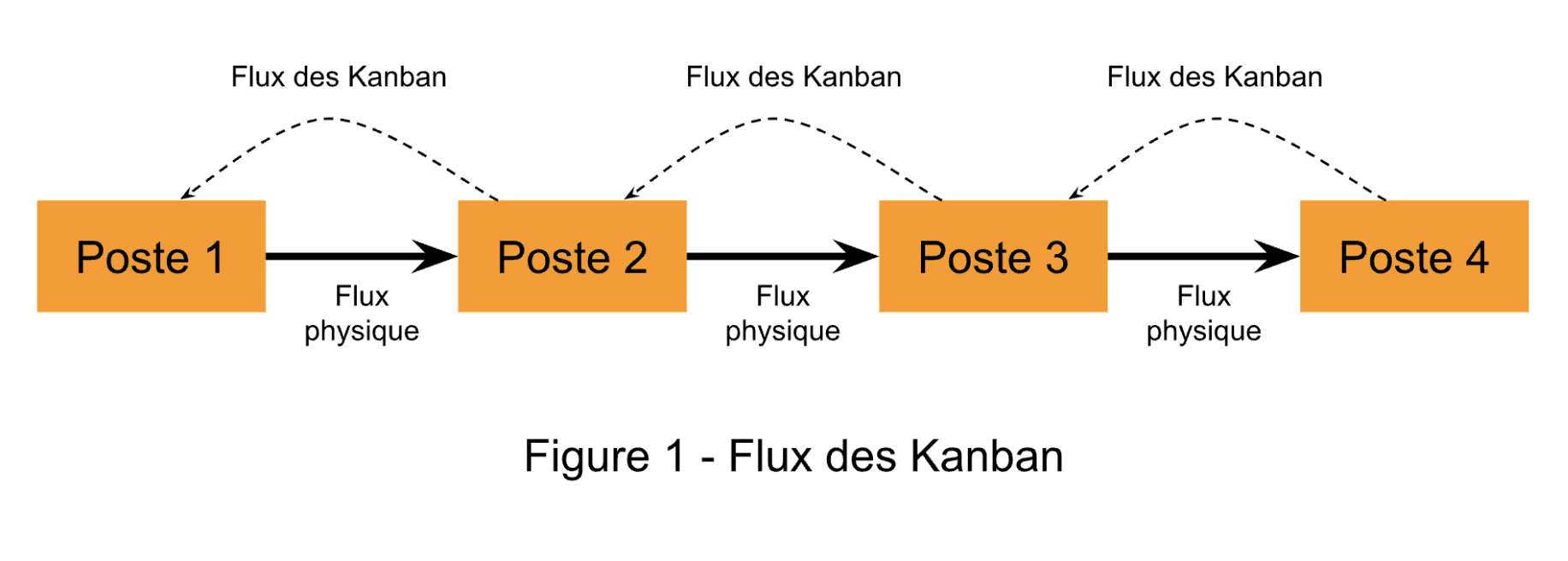
The specific Kanban method makes it possible to superimpose, on the production flow, a flow of kanban, therefore a flow of information, which goes in the opposite direction to the physical production flow (figure below).
If we zoom in between two workstations, you have to imagine that in front of each workstation there is a kanban production board (figure below). Each time workstation 2 consumes parts machined by workstation 1, it detaches the corresponding kanban label, which it sends back to workstation 1.
This label is a work order for a container of parts corresponding to the kanban label. Once workstation 1 has completed the work order, it attaches the corresponding Kanban label to the container and places it in front of workstation number 2.
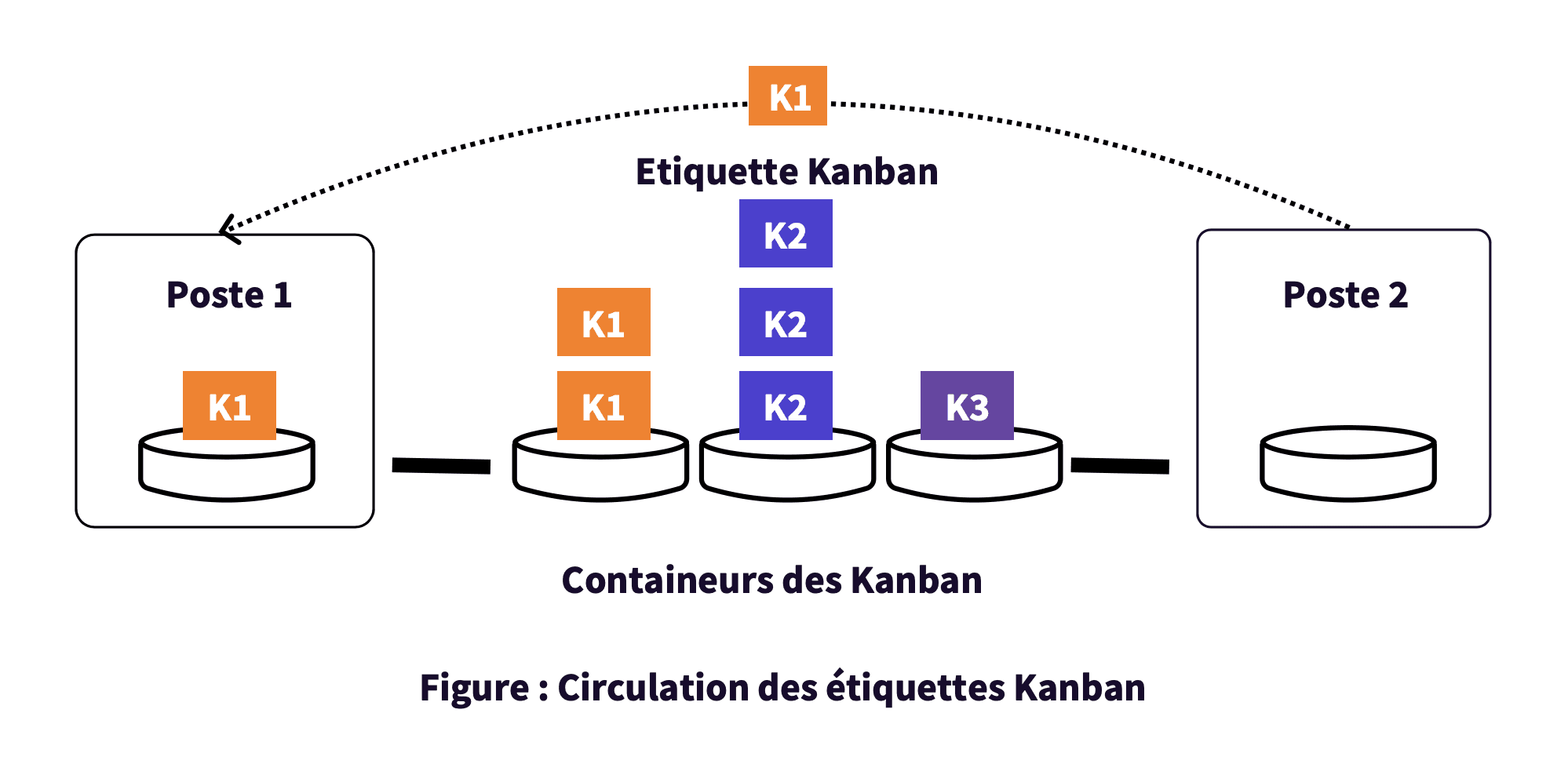
As long as there are kanban labels in front of the work center, I produce. Otherwise, I do not produce. With the Kanban method, production is driven by downstream needs.
We therefore reason on a pull-flow basis.
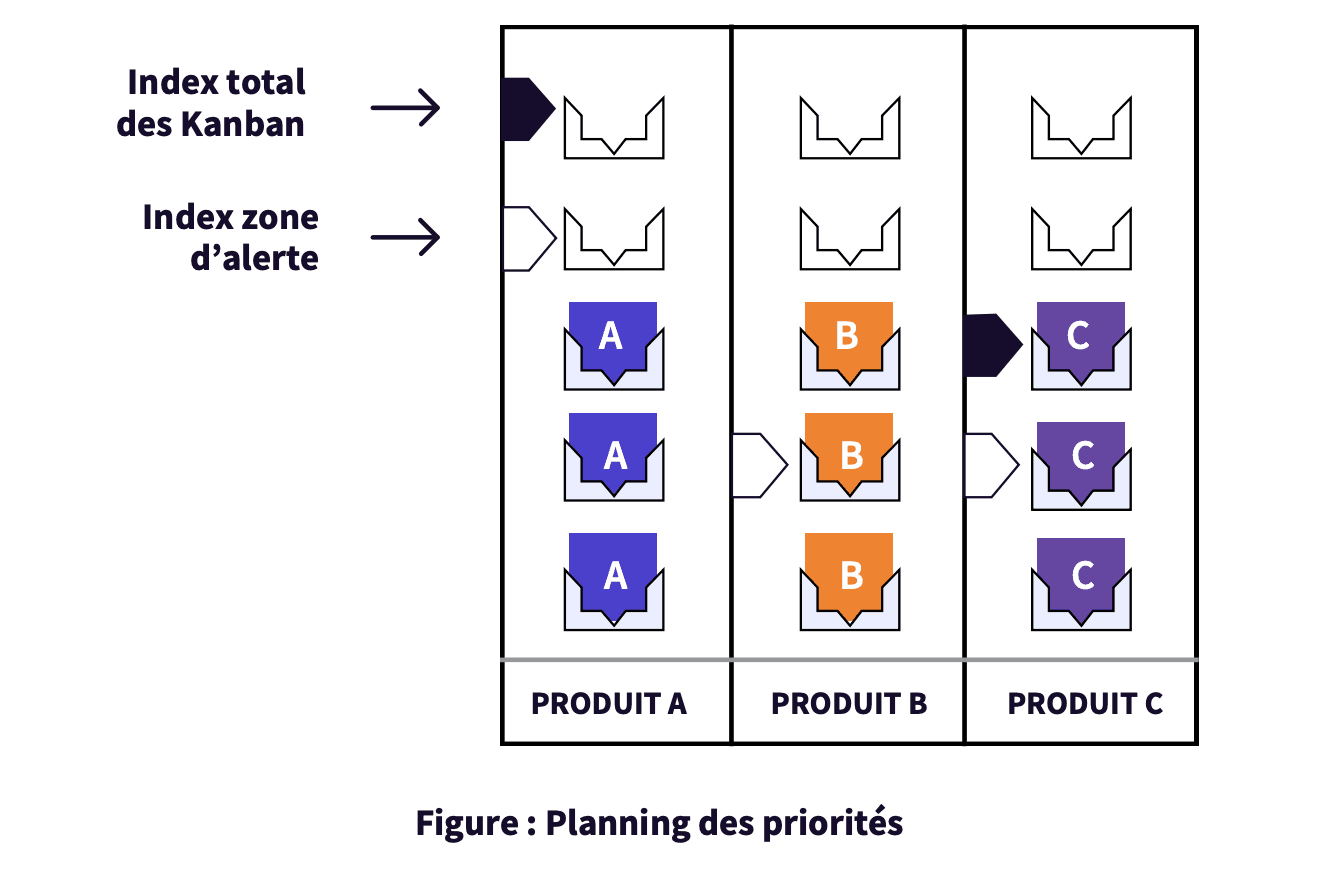
For this, we use a total kanban index and an alert-zone index.
1) The first indicates the total of each type of Kanban that can be absorbed.
2) The second indicates the alert zone beyond which production must be launched.
In the case of the figure below, the priority production is that of product C because it is the one closest to the alert zone and to the total kanban index.
The information found on a Kanban
Reference of the manufactured part
Container capacity (therefore quantity to produce)
Address or reference of the upstream supplier workstation (here workstation 1)
Address or reference of the downstream customer workstation (here workstation 2)
Limits of the specific Kanban
Does not make it possible to manage a large number of products and components.
Alternative to Kanban
The CONWIP method
If we take the specific Kanban method again, workstation 3 draws from the work-in-progress of workstation 2, which itself draws from that of workstation 1. The flow is pulled by the downstream.
However, this method does not adapt to sudden production changes. Suppose we produce a product A for a while. Suddenly, workstation 4 is informed that it must produce a product B. It will take a certain amount of time before the information goes back up to workstation 1.
The goal of the CONWIP method is to send this information, which is available downstream, as quickly as possible, to the beginning of the production chain. For example, once the information is received at workstation 3 that a product X must be produced, a kanban is sent to workstation 1 informing it that product E must be produced. This production will then be pushed all the way to workstation 3.
To be more precise, rather than talking about a Kanban label, we talk about a CONWIP ticket. Each ticket is generic, that is to say that they are assigned to a specific work order.
Once this work order is completed, the ticket becomes blank again. To take our example again, once product X is completed at workstation 3, the CONWIP ticket becomes blank again and is ready to accept a new type of product to produce (in our case product E). The ticket is then returned to the beginning of the line or to the previous buffer. This ticket then constitutes a work order.
As long as there is no blank ticket on the CONWIP board, the entry of new work orders onto the line is not authorized. And we can divide the production line according to the identified buffers. This makes it possible to have several CONWIP flows on the chain.
These methods make it possible to surface problems within the workshop. Rather than accumulating stock, the Kanban solution proposes to reduce it in order to reveal the places in the workshop that are a source of disruption.
Information circulates quickly within the workshop and between the workstations (machine problems, breakdowns, defective parts...) and the dependence between the workstations fosters cohesion within the factory.
Lead times and customer satisfaction are improved. These methods make it possible to deliver a little of everything every day and therefore to adapt to customer demand, which is increasingly volatile.
They foster the reduction of stock, which leads to a reduction in cash tied up and a gain in space in the factory and in the warehouses, which facilitates stock management.
Responsiveness is higher throughout the production chain, which is then more flexible.