Supply Chain
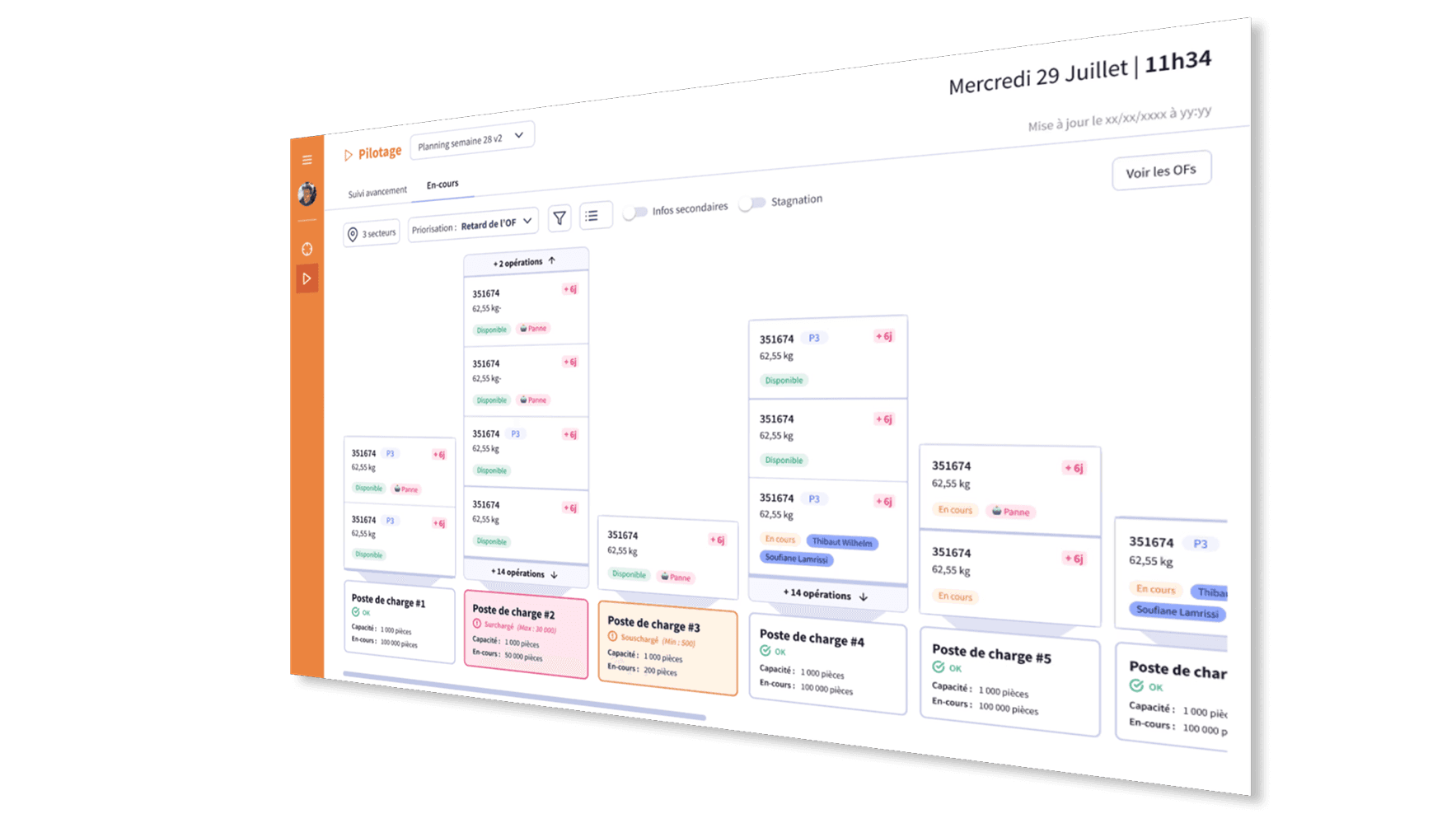
The manufacturing industry faces growing complexity: variability in customer orders, supply tensions, a proliferation of regulatory constraints, and heightened competition. In this context, production scheduling has become a daily headache for planners and schedulers. Between the Excel files piling up, the endless meetings, and the time-consuming manual adjustments, operational efficiency takes a hit. Yet a promise has emerged in recent years: that of intelligent scheduling capable of computing a complete, optimized, and realistic schedule in under a minute. A mere marketing claim, or a genuine technological breakthrough? Does artificial intelligence applied to industrial scheduling really change the game? This article examines that question in depth, drawing on factual data, concrete field feedback, and an analysis of the technologies available on the market.
Why scheduling remains one of the biggest industrial challenges
An environment that has become impossible to manage manually
Industrial scheduling consists of organizing the execution of work orders over time while accounting for multiple constraints: machine availability, operator skills, production rates, customer deadlines, bottlenecks, and sequencing constraints. This activity, once complex but manageable, has become a real challenge in the context of Industry 4.0.
Variability has become the norm. On the customer side, orders are increasingly irregular, with ever-shorter delivery times and growing customization requirements. On the supplier side, procurement delays and quality problems regularly disrupt production plans. Internally, contingencies multiply: unexpected machine breakdowns, operator absences, quality non-conformities that require rework.
The limits of traditional tools
Excel: flexible but fragile
Excel remains the most widely used scheduling tool in industrial SMEs. Its apparent flexibility actually hides many structural weaknesses. The risk of errors is high, particularly during the many copy-pastes needed to update schedules. Real-time recalculation is impossible, which means every major change requires several hours of manual work. Finally, the processes are not reproducible: each planner develops their own files and methods, making the onboarding of new employees particularly long and complex.
Classic APS: powerful but cumbersome
First-generation APS (Advanced Planning and Scheduling) systems do offer advanced mathematical optimization capabilities, but their configuration is extremely complex. It often takes several months, or even years, to set up these systems correctly. Moreover, their models are relatively static and poorly suited to volatile industrial environments characterized by frequent changes. Computation time can also be a problem: some optimization engines require several tens of minutes, or even hours, to produce a complete schedule.
Why teams still spend hours scheduling
Effective scheduling could reduce production lead times by twenty to thirty percent and improve productivity by fifteen to twenty-five percent. Yet most manufacturers are still far from these levels. Planners spend between fifty and seventy percent of their time consolidating information from multiple sources, manually maintaining files, and correcting errors. The lack of real-time visibility into the actual state of production further complicates the situation. Finally, updating the schedule in the event of a contingency (machine breakdown, urgent order) is so tedious that many give up doing it systematically, preferring to manage priorities “on the fly” on the floor.
Scheduling in under a minute: myth or technological breakthrough?
The criteria for true intelligent scheduling
A complete computation, not a simple priority sort
True automatic scheduling is not limited to sorting work orders by due date. It must perform a complete computation that takes all constraints into account and produces an optimized sequencing of operations across all resources. This difference is fundamental: a simple priority sort can be done in a few seconds, but it does not constitute scheduling in the technical sense of the term.
Taking all constraints into account
A scheduling engine worthy of the name must simultaneously incorporate machine constraints (availability, speeds, bottlenecks), operator constraints (skills, availability, assignments), sequence constraints (process routings, mandatory sequences), and time constraints (due dates, delivery windows). Intelligent scheduling must also manage production bottlenecks proactively.
Instant multi-scenario simulation
Beyond computing an initial schedule, a modern solution must make it possible to quickly simulate different scenarios to assess the impact of alternative decisions. What happens if you add an extra shift? How does the schedule react if you prioritize a given customer? These what-if simulations are essential for decision-making, but they only have value if they are near-instantaneous.
Why market solutions could not do this until now
Traditional optimization engines rely on operations-research algorithms (linear programming, constraint programming) that are powerful but computationally demanding. For a medium-sized shop with a few dozen machines and several hundred work orders, computation time can easily exceed an hour. Moreover, these mathematical models are rigid: any change to the rules or constraints requires expert intervention. Finally, the centralized architecture of these systems was not designed for real time, a major limitation in modern industrial environments where responsiveness is essential.
What a solution capable of scheduling in under a minute must do
Real-time data unification
Work orders, resources, skills, and rates
A real-time scheduling solution must first have a unified, up-to-date view of all relevant data. This includes work orders with their complete process routings, the availability status of machines and tools, operator skills and availability, as well as the actual observed rates (and not merely theoretical ones).
Integration with ERP, MES, and operator scheduling
Integration with existing information systems is crucial. Data must flow smoothly between the ERP (which manages orders and bills of materials), the MES (which reports the actual progress of production), and the human-resources planning tools. This connectivity ensures that scheduling is always based on up-to-date, reliable information.
A hybrid optimization engine combining AI and business rules
AI to predict durations, probable delays, and impacts
Artificial intelligence brings an essential predictive dimension to modern scheduling. By analyzing production history, machine-learning algorithms can predict the actual durations of operations with far greater accuracy than theoretical standards. They can also anticipate delay risks by identifying recurring patterns. According to 2024 data from INSEE (France's national statistics institute), ten percent of French companies use at least one artificial-intelligence technology, a figure rising by four points per year.
A combinatorial engine for multi-criteria optimization
Beyond predictive AI, true intelligent scheduling also requires a combinatorial optimization engine capable of handling discrete constraints (assignments, sequences) and quickly finding good-quality solutions. Modern heuristic algorithms make it possible to obtain results in a few seconds, where exact solvers would require hours.
A clear interface to validate, simulate, and adjust
Usability is a decisive success factor. An automatic scheduling solution must not be a “black box”: planners must be able to quickly visualize the schedule, understand the trade-offs made by the algorithm, and adjust manually if necessary. Drag-and-drop, instant recalculation, and multi-scenario simulation features have become standards expected by users.
How Oplit makes scheduling “simple and intelligent” in under a minute
A new-generation computation engine
Oplit has developed a scheduling engine capable of computing a complete schedule in a few seconds, even for complex shops with several dozen machines and hundreds of work orders. This performance relies on a distributed computation architecture and advanced heuristic algorithms. The system natively handles multi-bottleneck configurations and provides optimality metrics that make it possible to assess the quality of the solution obtained.
Predictive AI built into the core of the algorithm
Predicting the completion date of work orders
The Oplit Copilot feature uses artificial intelligence to predict the probable completion date of each work order. By analyzing the history of similar production runs, real-time constraints, and the defined business objectives, the solution offers a reliable estimate that takes past experience into account. This predictive capability helps planners identify orders at risk of delay early.
Automatic risk detection and recommendations
The system continuously analyzes production data and automatically detects abnormal situations: lengthening queues, machines approaching their maximum capacity, orders at risk of missing their delivery date. For each alert, Oplit Copilot offers adjustment recommendations based on the analysis of similar past situations.
Multi-criteria automatic scheduling
Oplit makes it possible to schedule while simultaneously accounting for multiple criteria: meeting customer deadlines, defined priority levels, available capacity, sequences imposed by manufacturing routings, and the actual availability of operators and machines. The user can weight these different objectives according to the company's strategic priorities. This multi-criteria flexibility distinguishes modern solutions from rigid first-generation systems.
Instant scenarios: one click for a simulation
One of the features most appreciated by users is the ability to instantly generate alternative scenarios. In one click, the planner can simulate the impact of adding a shift, a change in priorities, or a machine breakdown. These what-if simulations enable informed decision-making during planning meetings, where it previously took several hours to manually reassess the options.
An ultra-simple user experience
Oplit was designed to be accessible without lengthy training. The initial configuration does not require mathematical-modeling skills, unlike traditional APS. The interface adapts to the user's profile: simplified for beginners, with advanced features progressively accessible for experts. This approach eliminates the need to maintain a team of internal consultants dedicated to administering the system.
Case studies: how manufacturers save several hours a day
🧪 Chemical manufacturer
Use case: Many small orders for class C items led to multiple changeovers. Oplit was used to predict the likelihood of similar orders over the next 3 months.
Operational gain: 1 changeover saved per day per site, across 20 sites.
Financial gain: €8M
⌚ Watchmaking manufacturer
Use case: Multi-level bills of materials with minimum/maximum stocks at each level, leading to inefficient local optimizations. Oplit enabled a transition to a holistic approach based solely on finished-product requirements.
Operational gain: 30% reduction in work-in-progress, down from €100M to a more optimal level.
Financial gain: €3M
✈️ Aerospace manufacturer
Use case: Multiple constraints related to skills, tooling, and raw-material shelf life, causing production stoppages and low scheduling stability.
Operational gain: +2% OEE thanks to fewer stoppages caused by changeovers and last-minute schedule updates.
Financial gain: €1.5M
Dream or reality? In summary: yes, intelligent scheduling in under a minute is possible
The necessary conditions
For intelligent scheduling in under a minute to become operational, three conditions are essential. First, the data must be unified and reliable: up-to-date work orders, complete process routings, actual resource availability. Second, artificial intelligence must be natively integrated into the scheduling engine to bring prediction and continuous learning. Third, the computation engine must rely on modern algorithms capable of quickly handling large-scale combinatorial optimization problems.
What this changes for a factory
Responsiveness multiplied by ten
With near-instantaneous scheduling, the factory's responsiveness is transformed. Faced with a contingency (machine breakdown, urgent order), the planner can recompute a new schedule in a few seconds and immediately share it with the field teams. This agility was impossible with traditional methods that required several hours of manual work.
Reduced delays and improved service level
Case studies consistently show an improvement in the on-time delivery rate after deploying an intelligent scheduling solution. This improvement is explained by better anticipation of bottlenecks, optimized prioritization of orders, and the ability to quickly simulate different scenarios to choose the best one.
Less mental load for teams
Automating scheduling frees planners from repetitive, low-value-added tasks (manual consolidation, copy-pasting, updates). They can thus focus on higher-value activities: performance analysis, continuous improvement, supporting field teams, and strategic decision-making.
A reproducible and reliable process
Unlike Excel files customized by each planner, an automatic scheduling solution guarantees a standardized, reproducible process. The scheduling rules are explicit and documented. The onboarding of new employees is considerably simplified. Business continuity in the event of an absence is ensured.
Conclusion
Simple, intelligent scheduling in under a minute is no longer a dream but a technological reality accessible to manufacturers. The combined progress of artificial intelligence and optimization algorithms has made it possible to achieve a major breakthrough: where it once took several hours of manual work to build a schedule, it is now possible to obtain a complete, optimized, and realistic schedule in a few seconds.
This transformation is not only about computation speed. It profoundly changes the nature of planners' and schedulers' work, allowing them to move from an executor's posture (spending hours manually building schedules) to a strategic-pilot's posture (defining objectives, arbitrating between scenarios, managing performance). The results measured at customers who have taken the plunge are telling: efficiency gains of ninety percent for planners, a ten-to-fifteen-point improvement in customer service level, and a significant reduction in lead times and inventory.
Of course, this transformation requires prerequisites: quality data, integration with existing systems, and change management for the teams. But for manufacturers who want to remain competitive in an increasingly volatile and demanding environment, intelligent scheduling is no longer an option but a strategic necessity. The question is no longer whether scheduling in under a minute is possible, but rather how and when to deploy this technology to capture all its benefits.