Solutions
Let's start with the ERP.
This is where the MES comes into play.
Finally, there is GPAO software.
Making a choice among all these solutions.
Manufacturers today have several tools at their disposal to manage and optimize their production. ERP, MES, GPAO software, plenty of acronyms but little clarity in this market, so let's try to see things more clearly.
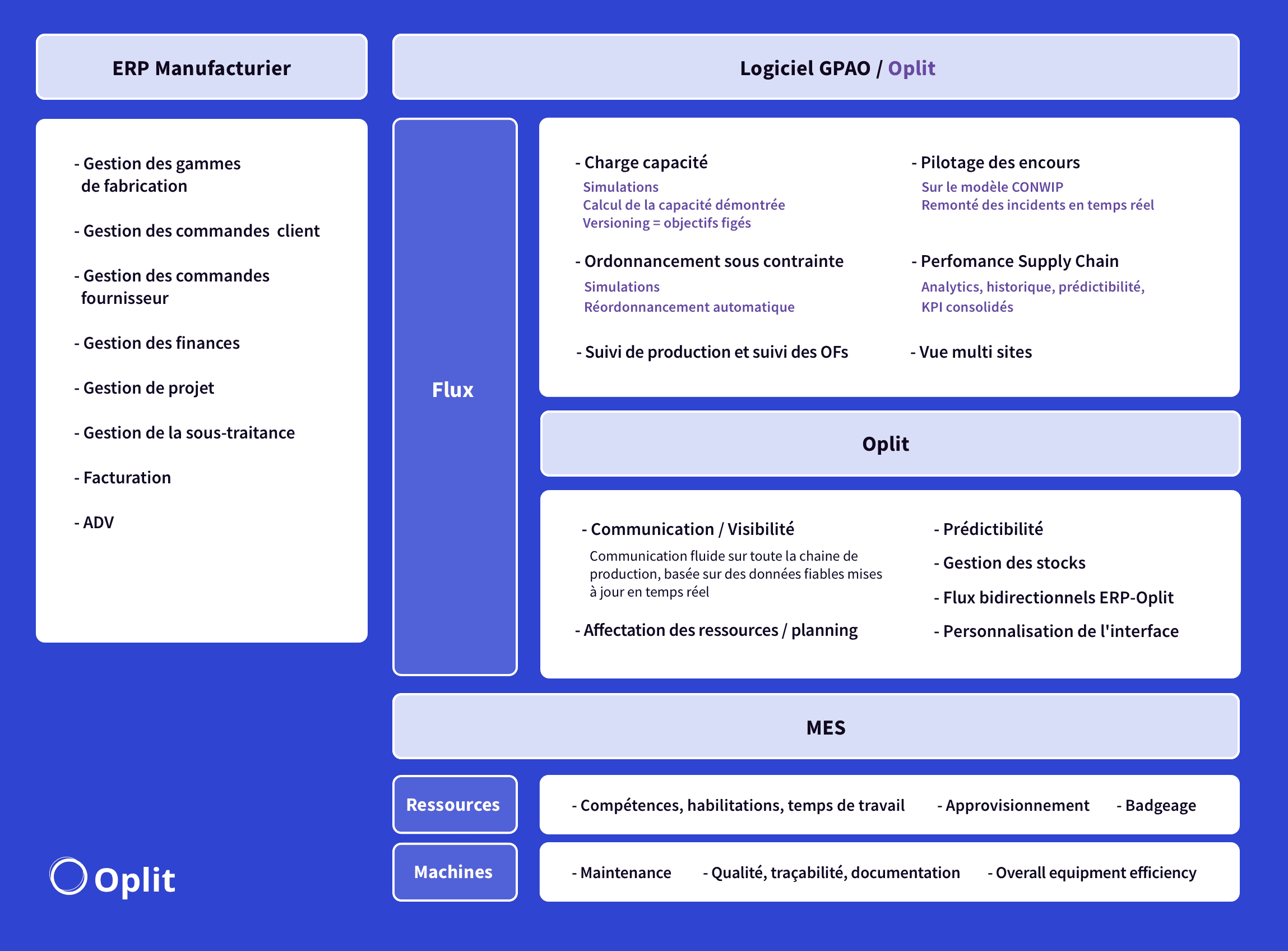
The ERP (enterprise resource planning) is a company-wide global system whose main purpose is resource management. There are specific ERPs for companies with so-called manufacturing activities: manufacturing ERPs (previously called MRP).
They make it possible in particular to manage stock, planning, orders, and quality control. These features will immediately allow you to increase your productivity, your customer satisfaction, and your compliance, to automate processes, and to centralize your data.
However, managing production flows or managing machines is not the ERP's core business. The ERP is therefore a must for any industrial company, but there are other technologies that will augment it by integrating perfectly, and that can manage load-capacity or maintenance issues in a much more agile and effective way.
The MES (manufacturing execution system) provides the link between the ERP and the process-control systems present on the shop floor.
In terms of features, an American and international standard has been put in place, the ANSI/ISA-95 standard, which defines the 11 essential functions of the MES:
The MES's features can ultimately be divided into two parts: Resources and Machines.
Concretely, the "resources" part of the MES makes it possible to manage team attendance, but also the clocking of operations, traceability, documentation, quality, and supply, and makes it possible to measure productivity as a whole.
Finally, the "machines" part of the MES makes it possible to manage maintenance but also the OEE (Overall Equipment Effectiveness).
Unlike many ERPs, the data is collected automatically by the MES and consolidated, which makes it possible to have a real-time view of the workflows and their performance. The teams can then focus a little more on continuous improvement.
GPAO software (computer-aided production management) will make it possible to effectively manage your production flows whether you are a discrete-manufacturing company producing in high or low volumes - working make-to-order or make-to-stock.
GPAO software incorporates both the strategic vision and the operational vision, which is why it will help you carry out your S&OP (Sales & Operations Planning) as well as your MPS (Master Production Schedule) and load plans (PDC).
At a time when resilience is key to staying the course in the face of the many unexpected events, GPAO will help you gain agility and flexibility.
GPAO solutions can incorporate the processes specific to each company, and make it possible to configure their structure, their routings, and their work centers, because every production site is unique and has its own characteristics.
Concretely, GPAO solutions make it possible to work on the load-capacity balance, to carry out optimized constraint-based scheduling, to manage work-in-progress, and to track work orders and production in general.
Finally, they also make it possible to monitor the performance of the supply chain as well as that of all the production sites (multi-site view).
And what about Oplit?
Oplit is a SaaS platform that is close to a GPAO software because managing production flows is its core business.
With the goal of allowing each player in the production chain to gain autonomy by having the means to make the best possible decision at any moment, Oplit is also an excellent inter-department communication tool.
Oplit also augments certain features of classic GPAO software by pushing them further. Indeed, you will be able, for example, to run load-capacity and scheduling simulations. Once the simulation is validated, you will be able to send it to the operators on the ground so that they can become aware of the priorities to handle. The order of priority can be modified according to rules suited to each work center.
Finally, regarding performance, you will be able to track your work orders and your production targets, frozen or not, in real time. You will be able to track your analytics and the history of your data on one or several production sites, simultaneously. This data history is precious because it will allow Oplit to bring you predictability, notably regarding the finish dates of work orders.
Today there is a plethora of solutions on the market whose boundaries between ERP, MES, and GPAO software are sometimes thin (ERP-GPAO, etc.). Some modules are basic while others carry a multitude of features. You must therefore first remain vigilant about the quality of the software as well as the quality of the support. Implementation is always a complex step; you need to be well supported. Finally, modularity is also an essential point because your needs can evolve.
In the end, when you are looking for a piece of software, you must think about your current issues but also your future issues. Anticipate as much as possible. The money and time spent when deploying such tools are often significant. Changing them is a colossal project, so no rushing.
List the solutions, modules, and features already deployed at your site, carry out a needs analysis, produce a fresh-eyes report and a diagnosis of your company's production, and set objectives!
What was not working until now? What is missing to optimize the management of your production? Also consult all the stakeholders within your company so that the new tools serve as many people as possible.
Finally, if possible, write a requirements document and structure your benchmark.
In conclusion.
In the end, the essential thing for industrial sites will be to approach this question of digitalizing their supply chain function by function, according to today's objectives but also tomorrow's. They will need to ensure the quality of the software but also of the service / support provided by the vendors. Finally, they will need sponsors within their teams, capable of promoting the deployed solutions to boost their adoption rate.