Best practices
Initial configuration and evolution of the DDMRP model
The operational aspects of DDMRP
Summary & limits of DDMRP
The MRP method and the Lean method (Kanban) are two so-called classic production-planning methods considered increasingly unsuited to the changes in the industrial ecosystem.
The MRP method and the Lean method (Kanban) are two so-called classic production-planning methods considered increasingly unsuited to the changes in the industrial ecosystem.
The MRP method is based on requirement calculations from history and forecasts. Knowing that every forecast is wrong and that we are evolving in an increasingly unpredictable world, this method is very sensitive to "bullwhip" effects (= rapid shift from a shortage situation to excess stock).
The Lean method (e.g. Kanban) is based on the assumption of independence of items along the production chain and a steering based on real consumption and not on forecasts. It is suited to productions where demand is stable and regular, where the risks of forecasting error are low.
Since the beginning of the 21st century, industry has been evolving in a context characterized by the acronym VUCA: Volatility of markets, Uncertainty of demand, growing Complexity of products, and Ambiguity of the cause-and-effect relationships of past interactions. To take this context into account, two researchers, Carol Ptak and Chad Smith, devised a production-scheduling tool that they describe in their work "Orlicky's Material Requirements Planning, 2011: DDMRP (Demand Driven Material Requirements Planning)".
DDMRP is applied mainly in three areas: purchasing, distribution, and production. This scheduling method takes elements from Lean and MRP while integrating demand. We thus obtain an MRP driven by demand that revisits the notion of stock, which then becomes an intermediary between production and demand.
The DDMRP method can be deployed at the supply, production, and distribution levels of an organization. Its implementation is divided into 5 steps.
Step 1:
Position the strategic stock buffers. This makes it possible to divide the production process into independent links. This division has an impact on scheduling and potentially on all the logistics flows (e.g. a supplier fluctuates its production and deliveries to customers according to the evolution of the buffers). To position the buffers, we take into account both the supply chain and the bill of materials of the finished product.
The positioning factors are the following:
Lead time expected by customers
Market opportunity lead time
The horizon of sales-order visibility
External variability
The stock leverage and flexibility point
The protection of critical operations.
Step 2:
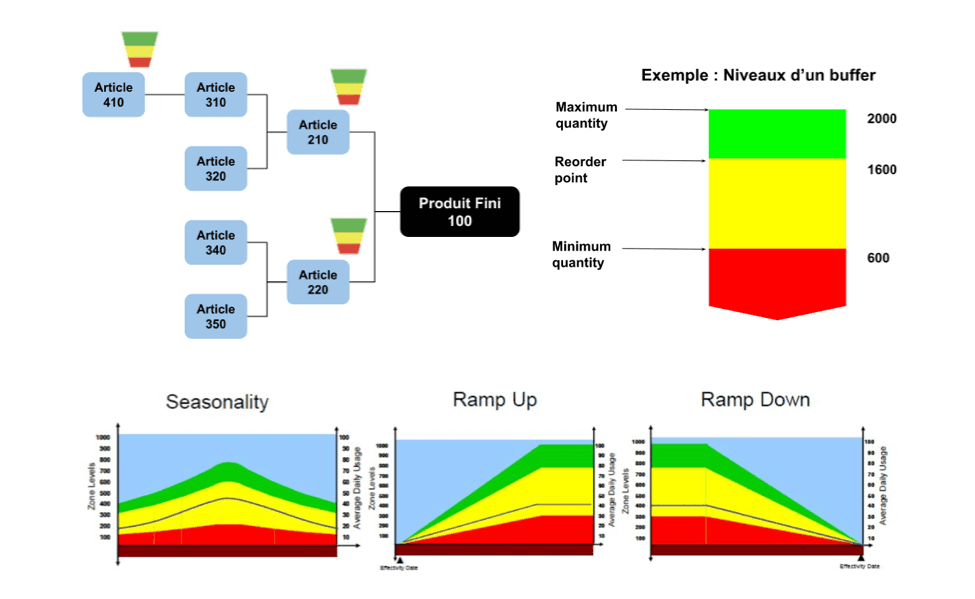
Size the stock buffers. You must ensure that the buffers are able to absorb the sources of variability (demand, management, operations, supply...) and to guarantee economic profitability. For each buffer, there are three color zones:
Green for the rotating stock level
Yellow for the coverage of the decoupled lead time. This quantity makes it possible to cover the supply lead time. This part of the buffer is not necessarily in stock but sometimes in production.
Red for the safety zone that makes it possible to absorb the variability shocks
The last sizing element is the parameter for calculating the three zones: the average daily consumption of the product.
Step 3:
The adjustment of the buffer levels according to the evolution of the item's attributes. In a VUCA context, you must constantly update the buffer levels. This can be periodic readjustments (seasonality, launches, discontinuations) or a total resizing of the calculation parameters if the context persists over time.
Step 4:
DEMAND DRIVEN PLANNING - planning replenishments from real demand. The available-flow equation calculates each day, for each buffer, whether an order must be planned. For this, it takes into account the quantity of stock, the on-order quantities, and the qualified demand.
Available flow = stock + supplies - approved demand
We relaunch the buffer's supply as soon as the available stock leaves the green zone toward the red or yellow zone. We will then plan a work order upstream of the loop corresponding to the decoupled cycle (start of the production line, or previous buffer). If the buffer's flow equation is:
In green: no work-order launch
In yellow: work-order launch in order to reach the green zone
In red: priority work-order launch to reach the top of green so as not to disrupt the supply chain.
Step 5:
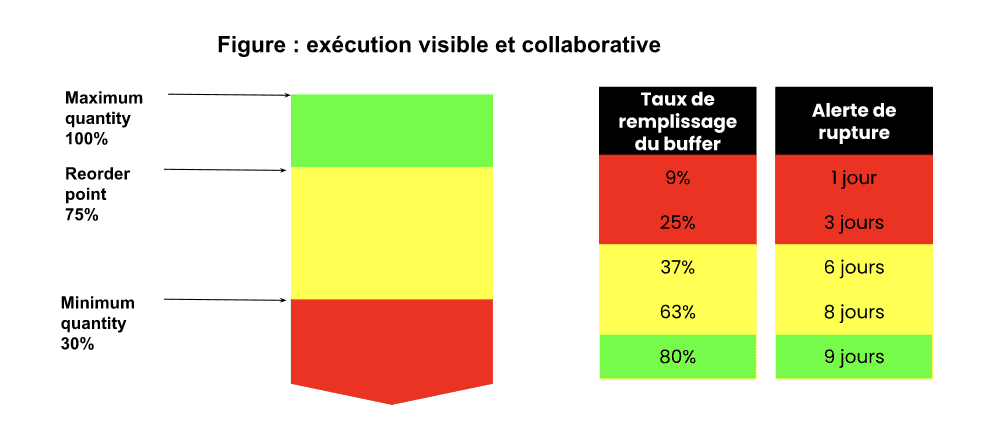
Visible and collaborative execution. With DDMRP, the great innovation is that we decide to launch a work order no longer according to its age but according to the buffer's fill rate.
Like a living being, the buffer must "eat," "fill up." Depending on the buffer's fill rate, an alert will be sent if production is stopped for a certain time. For example, if the buffer's fill rate is 63%, an alert will be sent to the planning and supply teams after 8 days without production.
It tracks the orders launched and transmits alerts from two indicators: the result of the available-flow equation and the physical stock of the item. An alert is sent when the stock moves into the red zone at the tracking level.
These alerts can also serve as indicators to assess the proper sizing of the buffer or its performance. The visual management of the tracking is one of the elements of DDMRP particularly appreciated by planners.
The DDMRP method makes it possible to reduce variability and gain profitability. Production manages its stock better and copes better with the multiple changes in priorities. However, it is a method that remains "young." The research articles are quite few, and there is no consensus among professionals on many points. Thus, many manufacturers decide the buffer parameters themselves, ultimately conditioning the performance of production and of the method.
Source:
“Compréhension du DDMRP et de son adaptation: premiers éléments empiriques”, 2019, Baptiste Bahu, Laurent Bironneau & Vincent Hovelaque
“Demand Driven Material Requirements Planning (DDMRP): A Systematic Review and Classification”, Azzamouri, Baptise, Dessevre, Pellerin, 2020
Accélérer les flux dans la Supply Chain grâce au DDMRP, XL Consultants