Solutions

What AI really brings to industrial planning: time savings and better decisions
Artificial intelligence is no longer science fiction for industrial directors. In 2025, 10% of French companies use at least one AI technology, according to INSEE, and that figure keeps growing. But beyond the hype, what does an industrial AI solution concretely bring to the planners and schedulers who manage dozens of work orders, hundreds of constraints, and thousands of decisions every day?
The answer comes down to two measurable benefits: time savings and better decision quality. According to market data, manufacturers that have integrated an industrial AI solution into their planning processes see, on average, a 20% reduction in production lead times and a 15% drop in inventory costs. At Oplit, the results are even more impressive: 90% efficiency gains for planners thanks to automated decision-making, and up to 95% OTD (On-Time Delivery) at certain clients such as Teknor Apex.
These figures don't come out of nowhere: they reflect AI's ability to simultaneously process massive volumes of data that the human brain cannot grasp in real time. Concretely, Oplit Copilot, the new automated-scheduling industrial AI solution, makes it possible to reorganize work orders in real time according to hundreds of variables: machine availability, inventory levels, customer priorities, HR constraints, ongoing breakdowns.
The technological revolution under way marks the shift from traditional "optimizers" to AI-powered "scheduling agents". Where the old systems imposed daily updates that quickly became obsolete and focused on a single KPI, modern AI scheduling agents like Oplit Copilot adjust schedules in real time and optimize against several financial objectives simultaneously. The result: every planner can schedule as well as the company's best expert, and without time-consuming manual effort.
But AI does not replace people, it augments them. On production lines and in planning offices, it acts as an intelligent copilot, providing personalized recommendations: schedule adjustments, early alerts, optimal-sequencing suggestions, instant simulation scenarios. The interface adapts to the profile: simplified for beginners, detailed for experts.
Industrial AI solutions also transform the nature of planners' work. Rather than spending 50 to 70% of their time manually maintaining Excel files, copying and pasting data, and correcting errors, they can focus on strategic analysis, continuous optimization, and supporting field teams. The time freed up by AI becomes value-creating time.
The 5 AI use cases for industrial planning and scheduling
1. Planning copilot: intelligent priority suggestions
The first use case of an industrial AI solution is to assist the planner with their most critical task: setting priorities. Every day, a scheduler must decide which work order (WO) to release first among dozens of candidates. The criteria are many: customer due date, inventory level, component availability, machine capacity, late-delivery penalties.
Oplit Copilot acts here as an intelligent copilot. By analyzing the history of decisions, real-time constraints, and business objectives (service level, inventory turnover, load balancing), the industrial AI solution proposes an optimized prioritization of work orders. The planner stays in control and can adjust, but has a solid starting point computed in seconds instead of hours.
What sets Oplit Copilot apart from traditional solutions is its multi-objective approach driven by financial performance. Rather than optimizing a single KPI (for example, minimizing delays), the system intelligently balances several objectives: reducing finished-goods inventory, minimizing WIP (Work In Progress), maximizing capacity utilization, and improving the customer service level.
A copilot-type industrial AI solution goes further by explaining its recommendations: "I suggest prioritizing work order 4523 because the finished-product stock is at zero, the customer has a late penalty of €500/day, and machine M12 is available immediately." This transparency builds trust and lets the planner understand the logic, adjust it if needed, and gradually learn the good practices suggested by the AI.
The gains are concrete: a 40-to-60% reduction in the time spent manually prioritizing work orders, a 10-to-15-point improvement in the customer service level, and less decision-making stress for planners. At Teknor Apex, the first customer of Oplit's AI-first solution, 98% of decisions are now automated thanks to this capability.
2. Anomaly detection: alerts on delays and missing components
The second use case leverages AI's ability to detect anomalies before they turn into crises. In a factory, dozens of events can disrupt production: a component that doesn't arrive on time, a work order falling behind, a machine showing signs of weakness, an absent operator.
Oplit Copilot continuously monitors all these signals and proactively alerts the scheduler as soon as an anomaly is detected. For example: "Warning, work order 3421 should have been finished 2 hours ago but is still in progress on machine M05. Estimated impact: 3 customer work orders are at risk of delay." Or: "Component C789, needed to start work order 5678 tomorrow, has not yet been received. Current stock: 0. Next delivery expected: T+3."
This detection capability relies on the continuous analysis of ERP, MES, and shop-floor data. Industrial AI constantly compares the actual against the forecast and identifies significant deviations. It also learns to recognize weak signals: a drift tendency on certain machines, recurring delays from a supplier, quality-defect patterns.
The strength of Oplit Copilot lies in its ability to automatically adjust the schedule in real time as soon as an anomaly is detected. Unlike traditional systems that require daily manual updates, the industrial AI solution instantly recalculates the best possible schedule given the new constraint.
According to industry studies, early anomaly detection can reduce unplanned production stoppages by 25%. McKinsey also estimates that predictive maintenance combined with anomaly detection could generate savings of nearly $630 billion worldwide by 2025.
3. Intelligent optimization: advanced algorithms, simulation, and optimal sequencing
The technical core of industrial AI solutions lies in multi-constraint optimization. Scheduling complex industrial production is an NP-hard problem: there are billions of possible sequences to schedule 100 work orders across 20 machines, and finding the best solution exhaustively would take years of computation. This is where heuristic and metaheuristic algorithms (genetic algorithms, simulated annealing, ant colonies, tabu search) come in, intelligently exploring the space of possible solutions to find an excellent solution in seconds. Oplit Copilot goes further by adopting an AI multi-objective scheduler approach that simultaneously optimizes several financial-performance objectives: reducing inventory, lowering WIP, increasing capacity, improving the service level. The planner defines their objectives (minimize delays, balance the load, reduce changeovers) and their constraints (machine availability, operator skills, component availability), then lets the AI compute a 100% optimal schedule based on the defined strategic objectives. The difference from manual Excel scheduling is spectacular: a 15-to-25% gain in machine load rate, a 20-to-30% reduction in work-in-progress, a 10-to-20% improvement in service level. Beyond daily optimization, these solutions turn planning into a simulation laboratory. Before making an important decision (adding a shift, calling on a subcontractor, accepting an urgent order), industrial directors can test "what-if" scenarios instantly: "What happens if I add a night shift in week 15?" or "If I subcontract the 500 pieces of reference X, do I free up enough capacity for customer Y's urgent order?" Oplit Copilot computes these scenarios in seconds and visually presents the impact on service level, inventory, machine load, and costs, making it possible to compare several scenarios side by side. This capability turns S&OP meetings into informed decision sessions rather than theoretical discussions, with a 30-to-40% improvement in their effectiveness. Finally, AI targets a crucial challenge: reducing changeover times, which often account for 20 to 40% of lost productive capacity. Artificial intelligence analyzes the history and recommends intelligent groupings of work orders to minimize changeovers, then proposes optimal sequences taking into account product similarity, quantities, due dates, and inventory constraints. Unlike planners who take "shortcuts" leading to suboptimal schedules, Oplit's AI scheduling agent systematically computes the best possible sequence. This "Every planner schedules as your best planner" approach guarantees consistent scheduling quality regardless of the planner's level of experience, with productivity gains of 8 to 15% on the workstations concerned. At Teknor Apex, this global AI optimization delivered a 15% reduction in changeovers, 95% OTD, and full C-level engagement in strategic and financial trade-offs, as noted by Eduardo Marques, their Supply Chain Director.
4. Drift prediction: OTD and lead time under watch
The fourth use case leverages machine learning to predict drifts before they occur. Two indicators are particularly critical in planning: OTD (On-Time Delivery) and lead time (production time).
A predictive industrial AI solution analyzes production history, identifies delay patterns (certain references, certain suppliers, certain times of year), and predicts the probability that a work order will miss its delivery date. For example: "Work order 6789 has a 75% risk of delay. Identified factors: a critical component from a frequently-late supplier (history: 40% late), the summer holiday period (historical impact: +15% average lead time), machine M23 showing signs of degradation."
This prediction makes it possible to act proactively: alert the customer in advance, secure a plan B (subcontracting, overtime), adjust the schedule. Data shows that companies that anticipate delays rather than suffer them maintain a customer satisfaction rate 20% higher despite the same operational disruptions.
Oplit Copilot goes further by automatically adjusting the schedule as soon as a drift is predicted, without waiting for human intervention. This real-time responsiveness is impossible with traditional systems that require manual updates. The industrial AI solution ensures the schedule is always up to date and optimal given the latest available information.
Predictive industrial AI solutions also go further by identifying the root causes of lead-time drifts: a bottleneck workstation that is systematically saturated, a changeover that is too long, a quality check that blocks too often. These insights make it possible to launch targeted, measurable continuous-improvement initiatives.
5. Automatic generation of reports and action plans
The fifth use case transforms documentation and reporting, time-consuming but essential tasks. After every S&OP or MPS planning meeting, you have to produce minutes, list the decided actions, and track the owners. This task easily takes planners 2 to 4 hours a week.
Modern industrial AI solutions incorporate generative AI capabilities that analyze the decisions made in the system, the recorded discussions, and the tested scenarios, and automatically generate structured minutes: context, decisions made, quantified impacts, actions to take, owners, deadlines.
Industrial AI goes further by proposing intelligent action plans: "Problem identified: cutting-machine load rate at 110% in W15-W18. Decision: add a Saturday shift. Recommended actions: 1) Contact temporary workers (Owner: HR, Deadline: T+5), 2) Check tooling availability (Owner: Maintenance, Deadline: T+3), 3) Adjust the schedule (Owner: Planning, Deadline: T+7)."
With Oplit Copilot, this documentation is even simpler because all decisions are automatically traced in the system. The built-in Analytics Dashboard provides a complete view of performance: OTD trend, capacity utilization, inventory holdings, margin trend, changeover times. Planners can export these reports in one click for their management meetings.
This automation frees up valuable time and ensures that no decision is lost, a recurring problem in industrial organizations where handwritten minutes often end up in a drawer. Industrial directors who use these features see a 40% improvement in action tracking and fewer "pointless meetings."
Prerequisites and limits: data quality, MDM, change management, IT/security
While the benefits of industrial AI solutions are real and measurable, their deployment is not magic. Four major prerequisites determine success: data quality, Master Data Management (MDM), change management, and IT security.
Data quality: the foundation of any AI
AI doesn't work miracles with garbage data. This is the first lesson of every industrial AI project: if the bills of materials are wrong, if operation times are out of date, if the inventory levels in the ERP don't match reality, the AI will produce flawed recommendations.
Data shows that 80% of an AI project's time is spent cleaning and preparing data, and more than 40% of companies cite data quality or availability as the main barrier to AI ROI. Before deploying an industrial AI solution, you must audit and clean the master data: manufacturing routings, bills of materials, machine capacities, OEE, inventory.
Oplit supports its customers through this critical phase with a structured data-validation approach. The co-development process for Oplit Copilot begins with 6 weeks of data identification and validation, including defining the data model, the exhaustive list of constraints, and validating the KPIs used by the AI scheduler.
This phase can take 2 to 6 months depending on the size of the plant and the state of the data repository. It is often perceived as a constraint, but it brings intrinsic value: having reliable data already improves manual planning even before the AI comes into play.
Master Data Management: governance and consistency
MDM (Master Data Management) refers to the governance of reference data at group level. In multi-site organizations, each plant often has its own conventions: item coding, BOM structuring, work-center definitions. This heterogeneity makes it impossible to deploy an industrial AI solution at group scale.
Deploying industrial AI often becomes an opportunity to structure the MDM: standardize the repositories, harmonize processes, create shared governance. This effort mobilizes the IT department, methods engineers, and industrial directors.
Oplit, with its 100+ sites deployed across 12 countries and its prestigious clients (Saint-Gobain, LVMH, Tenneco), has developed unique expertise in multi-site deployment. The platform is designed to adapt to the specifics of each plant while enabling consolidation at group level.
Feedback shows that groups that succeed with their MDM see benefits beyond AI: the ability to consolidate data at group level, benchmarking between sites, and pooling of best practices.
Change management: supporting the teams
The third prerequisite is human: supporting planners and schedulers in adopting AI. Cultural resistance is a major potential obstacle. Moving from static, manual planning methods to real-time, data-driven scheduling requires a shift in mindset.
There are many fears: "Will AI replace my job?", "How can I trust a black box?", "Will I lose control of my planning?" These concerns are legitimate and must be taken seriously. Data shows that 60% of professionals worry that AI will make their job obsolete.
The vision of Oplit Copilot is clear: increase planner productivity by 90% by automating decision-making, but not by replacing planners. On the contrary, the industrial AI solution lets them focus on high-level decision-making: defining strategic objectives, financial trade-offs, continuous improvement. As Eduardo Marques of Teknor Apex puts it: "The C-level is now fully engaged in the scheduling process with strategic and financial trade-offs."
Change management relies on several levers: intensive training, transparent communication about the objectives and expected benefits, involving the teams in configuring the AI, and pilots on limited scopes before rollout. Oplit offers a structured 28-week co-development process with strong support commitment and recurring on-site visits.
IT and cybersecurity: protecting industrial data
The fourth prerequisite concerns IT security. Deploying an industrial AI solution means connecting the tool to critical systems: ERP, MES, production databases. These connections create potential entry points for cyberattacks.
According to statistics, in 2024, 2 million AI cyberattacks took place every day, and 56% of French manufacturers consider cybersecurity the top priority use of AI. IT and cybersecurity leaders must be involved from the start of the project.
Oplit is committed to the highest standards of quality and security:
SOC2 Type 2 certification for data protection
SSO auth for secure authentication
Native APIs for safe integrations
Dedicated infrastructure with strong SLAs
No-code setup minimizing configuration-error risks
These guarantees let manufacturers deploy Oplit Copilot with full confidence, including international industrial groups with high security requirements such as LVMH or Saint-Gobain.
Measuring the value: before/after KPIs and A/B process tests
To justify the investment in an industrial AI solution, industrial and financial directors need quantified proof. Three complementary approaches make it possible to measure the value created.
Define the KPIs before deployment
The first step is to establish a baseline of key indicators before deploying the AI. The classic KPIs include:
Customer service level (OTD): percentage of orders delivered on time
Machine load rate: actual utilization vs. available capacity
Work-in-progress level (WIP): value of work orders in production
Average lead time: time between releasing and delivering a work order
Planning time: hours spent by planners scheduling
Plan adherence rate: gap between the initial schedule and the actual
Changeover times: setup-change times between references
Finished-goods inventory: inventory level at the end of the line
These indicators must be measured over a representative period (3 to 6 months) to capture normal variability. This baseline will serve as the reference for measuring the gains after deploying the industrial AI solution.
Measuring the gains after deployment: Teknor Apex customer case
After 3 to 6 months of using industrial AI, the same KPIs are remeasured. Teknor Apex, a US leader in plasticizers with $1 billion in revenue, was the first customer to deploy the AI-first Oplit Copilot solution. The results after 16 weeks of onboarding are exceptional:
OTD: 95% (significant improvement vs. baseline)
Changeover reduction: 15% (sequencing optimization)
Share of automated decisions: 98% (freeing up planner time)
Increased responsiveness: schedule adjusted in real time by Oplit
Reduced inconsistency between the decisions of different schedulers
As Eduardo Marques, Supply Chain Director at Teknor Apex, testifies: "We had a vision of a dream solution. What we built with Oplit exceeds our expectations, with strong gains in both production capacity and team productivity."
The operational changes include:
AI-first scheduling: automatic real-time adjustment
Simple configuration: easy handling of new constraints
Strategic decisions: full C-level engagement in the process
These gains are not theoretical: they correspond to the results published by Oplit on its first AI-first deployment. Of course, results vary depending on the context, the maturity of the organization, and the quality of the deployment.
Oplit Copilot's ambitions: 2025 vision
Oplit is pursuing an ambitious roadmap with three strategic phases:
Phase 1 (completed ✅): Leader for discrete manufacturing with 100+ sites deployed, notably in luxury watchmaking (Richemont, Vaucher, Acrotec)
Phase 2 (completed ✅): AI-first solution for continuous manufacturing, with the success of Teknor Apex demonstrating the ability to automate 99% of decisions
Phase 3 (in progress ⏳): Extending AI-first to discrete manufacturing, with co-development involving 2-3 existing customers
Oplit Copilot's quantified ambitions:
+90% planner productivity through automated decision-making
Reduced finished-goods inventory thanks to multi-objective optimization
Reduced WIP via better production flow
Increased capacity without machine investment
ROI and payback time
Ultimately, the question of ROI (Return On Investment) arises. Oplit offers a structured 28-week co-development process including:
12 weeks of preparation (co-builder identification + project validation)
16 weeks of delivery (MVP + iteration + fine-tuning)
Go/No-Go after 30 weeks
The tangible gains include: reduced inventory (freeing up cash), improved service level (fewer late penalties, better customer retention), increased productivity (same output with fewer resources), reduced overtime.
Teknor Apex's early results show that Oplit Copilot can generate measurable impact within the first months of deployment. The co-development process makes it possible to validate the ROI progressively, with a mid-point Go/No-Go.
But the intangible gains also matter: reduced planner stress, improved quality of work life, the ability to attract and retain talent, an image of innovation with customers. These benefits are not easily quantified but create lasting value for the organization.
Conclusion: Oplit Copilot, the AI scheduling agent revolutionizing industrial planning
Industrial AI is no longer a futurist topic for plant managers and supply chain leaders. It is a mature, proven technology, deployed by hundreds of manufacturers in France and around the world. The five use cases presented in this article represent only part of the possibilities offered by modern industrial AI solutions, and particularly by Oplit Copilot, the new generation of intelligent scheduling agent.
The revolution is under way: manufacturers are moving from rigid, time-consuming "optimizers" to intelligent, responsive "scheduling agents." Where the old solutions imposed daily updates that quickly became obsolete and focused on a single KPI, Oplit Copilot adjusts schedules in real time, optimizes against several simultaneous financial objectives, and automates 98% of scheduling decisions.
The prerequisites are clear: quality data, structured MDM governance, serious change management, and a secure IT architecture (SOC2 Type 2 certification). These conditions may seem demanding, but they create value beyond AI by making the entire industrial information system more reliable.
The gains are measurable and significant, as proven by Teknor Apex, the first customer of Oplit's AI-first solution:
95% OTD (On-Time Delivery)
15% reduction in changeovers
98% of decisions automated
Real-time schedule adjustment
C-level engagement in strategic decisions
For industrial directors wondering where to start, Oplit offers a co-development program over 28 weeks with a mid-point Go/No-Go. The company is currently looking for 2-4 additional co-builders ready to shape the future of scheduling in discrete manufacturing.
This pragmatic approach, sometimes called "fail fast, learn fast," makes it possible to limit risks, learn quickly, and convince skeptics with facts. Modern industrial AI solutions like Oplit Copilot are designed for this kind of gradual deployment: no-code configuration, native APIs, simplified ERP/MES integration, responsive support with an in-house team.
AI is no longer a risky bet; it is a strategic investment. Manufacturers that adopt it today gain an edge over their competitors. Those who wait risk being overtaken by more agile players who use AI to produce better, faster, and cheaper.
The question is no longer "Should we adopt AI?" but "When and how do we start?" With Oplit Copilot, the answer is clear: start now with structured co-development, expert support, and the guarantee of the highest quality standards (SOC2 Type 2, native APIs, responsive support).
Discover Oplit Copilot: the new-generation AI scheduling agent
Oplit is the French leader in production planning solutions, with 100+ sites deployed across 12 countries and prestigious clients such as Saint-Gobain, LVMH, and Tenneco. With Oplit Copilot, the company is launching the new era of AI-powered scheduling agents.
Oplit Copilot automates 100% of scheduling decision-making based on your strategic objectives. You stay in control to dig deeper and correct if necessary, but the AI computes the best possible schedule in real time given all your constraints.
Why choose Oplit Copilot?
90% efficiency gains for planners
Real-time schedule adjustment (vs. obsolete daily updates)
Multi-objective optimization driven by financial performance
Every planner schedules like your best expert
SOC2 Type 2 certification and dedicated secure infrastructure
Contact us to discover how Oplit Copilot can transform your industrial planning. Join the co-builders shaping the future of scheduling and take part in building the benchmark AI-first solution.
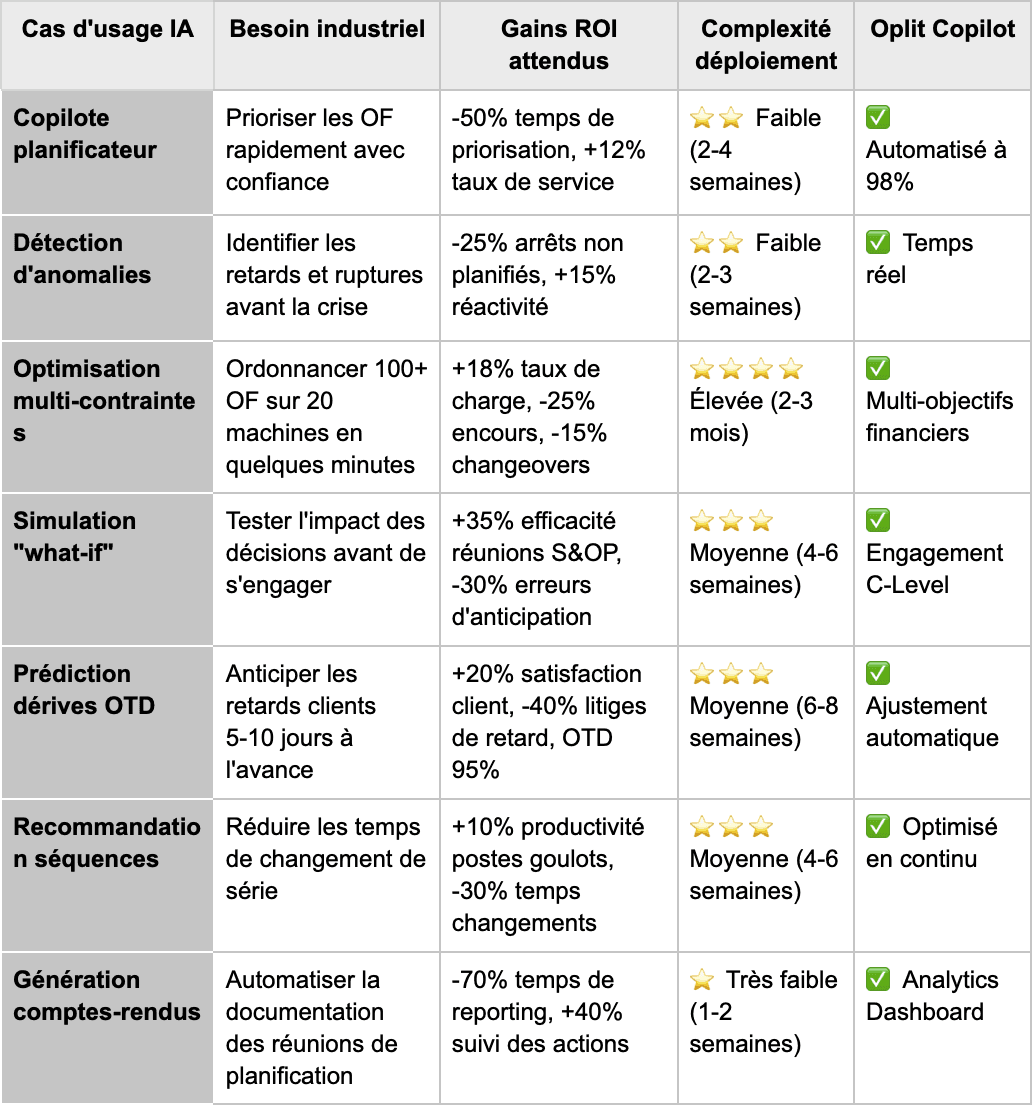
Summary table: use case, need, ROI, and complexity
FAQ: AI in industrial planning
Is AI a black box you can't understand at all?
No, the era of black boxes is over in modern industrial AI solutions. Serious vendors invest heavily in model explainability (explainable AI). Concretely, the AI explains each recommendation: "I suggest this priority because... (list of the 3-4 main criteria)." The planner understands the logic, can challenge it, adjust it, and validate it knowingly. Oplit Copilot takes this transparency even further with its "Deep-dive and correct if required" approach: planners can explore the AI's decisions in detail and adjust them if necessary. This transparency builds trust and enables gradual adoption. As Eduardo Marques of Teknor Apex points out: "Schedulers easily access the constraints and can modify them."
What about data security and cybersecurity?
Cybersecurity is the No. 1 topic for manufacturers: 56% of them consider data protection the top priority use of AI, according to Rockwell Automation studies. Industrial AI solutions must meet strict standards. Oplit is committed to the highest standards of quality and security: SOC2 Type 2 certification, SSO authentication, native APIs for secure integrations, dedicated infrastructure with strong SLAs, no-code setup minimizing error risks. These guarantees have enabled Oplit to win over prestigious industrial groups with high security requirements: LVMH, Saint-Gobain, Tenneco. The question to ask your vendor: "Where is my data hosted? Who has access to it? What certifications do you have?" Oplit provides clear answers and contractual guarantees.
Can you start small before scaling up?
Absolutely, and it is in fact the method recommended by Oplit. The company offers a structured 28-week co-development program with a mid-point Go/No-Go:
Weeks 1-6: Identifying co-builders and validating alignment
Weeks 7-12: Project validation (product requirements, pilot site, budget, team)
Weeks 13-16: MVP development with daily review of adjustments
Weeks 17-24: Product iteration with data-pipeline construction
Weeks 25-28: Fine-tuning and go-live (RUN)
This approach makes it possible to test the solution on a limited scope, measure the real gains (like Teknor Apex: 95% OTD, 15% changeover reduction, 98% automated decisions), adjust the configuration, and convince skeptics with facts. Oplit is currently looking for 2-4 additional co-builders ready to shape the future of scheduling in discrete manufacturing. Industrial directors who choose this pragmatic path see success rates 3 times higher than big-bang deployments.